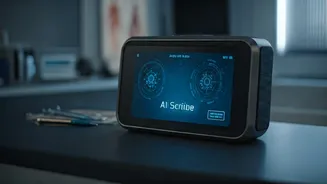








The Promise of an AI Assistant
The appeal of AI note-taking tools, often called ambient scribes, is undeniable. For years, clinicians have been drowning in administrative work. Studies show physicians can spend nearly half their day on documentation, a major driver of professional
burnout. These AI tools promise a solution by using advanced speech recognition to listen to a clinical conversation and automatically generate a summary for the electronic health record. In theory, this frees the doctor from the keyboard to focus entirely on the patient, potentially improving the quality of care, boosting efficiency, and giving clinicians back much-needed time. Some estimates suggest these tools can cut documentation time significantly, which is why their adoption in health systems is growing rapidly.
The Unseen Risks in the Room
Despite the benefits, the rapid rollout of AI scribes is outpacing our understanding of their risks. The first and most obvious concern is privacy. These tools record sensitive health conversations, which may include details about your identity, conditions, and family. This creates new avenues for data breaches, as highlighted by an incident where an unauthorized AI scribe recorded a virtual meeting discussing the health information of seven patients. Beyond breaches, there are questions about how this data is used. Patients may not realize their conversations could be used to train future AI models, a secondary use they never explicitly agreed to.
Accuracy and Accountability
Even more concerning are the risks of clinical errors. While often highly accurate, these AI systems are not perfect. They can misinterpret medical terms, miss critical details, or even "hallucinate"—inventing information that was never said. An AI might not understand the nuance in a patient's story or pick up on a non-verbal cue that a human clinician would. These errors, if missed by a busy doctor during review, become part of the permanent medical record and could lead to misdiagnosis or incorrect treatment. This raises a critical question of accountability. While tech companies market these tools with a "physician in the loop," ultimate legal and professional responsibility for the note's accuracy falls squarely on the clinician who signs off on it.
Forging a Path for Safe Adoption
The solution isn't to ban this promising technology, but to implement clear and robust rules to guide its use. First, patient consent must be explicit and transparent. It's not enough to rely on implied consent; patients must be clearly informed that an AI is listening and told how their data will be used, with the clear option to opt out. Second, we need industry-wide standards for accuracy, data security, and bias. AI models must be rigorously tested to ensure they work reliably for all patients, regardless of accent or dialect, to avoid perpetuating health disparities. Finally, regulatory bodies need to provide clear guidance. Many of these tools currently bypass strict evaluation as medical devices, creating an oversight gap. A clear framework would ensure these systems are safe and effective before they reach the exam room.