







A Daring Subsurface Peek
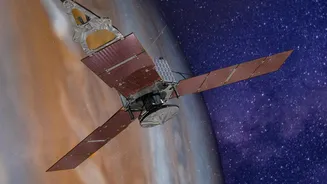
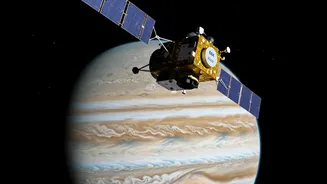
On December 30, 2023, and February 3, 2024, NASA's Juno probe flew within just 1,500 kilometers (about 930 miles) of Io's turbulent surface. The main goal of these flybys was to use Juno's Microwave Radiometer (MWR), an instrument originally designed
to study Jupiter's deep atmosphere, for a novel purpose: to take the temperature of a rocky moon's interior. Before this, our understanding of Io's immense heat was based on infrared observations, which can only measure the very top of the surface. The MWR, however, can sense thermal emissions from several feet below the crust, giving scientists their first-ever direct data on the heat simmering just beneath the ground.
Reading a Moon's Temperature
The results, recently published in the Journal of Geophysical Research: Planets, were surprising. Everywhere the instrument looked, it found temperatures rising sharply just a few feet underground. In some areas, the temperature jumped by more than 40 degrees Fahrenheit (over 22 degrees Celsius) in the shallow subsurface—a much steeper gradient than sunlight alone could ever explain. This finding suggests a powerful internal heat source is constantly pushing energy outward. Scientists have two main theories for how this heat moves. It could be rising steadily through a conductive crust across the entire moon. Alternatively, the heat could be coming from vast, cooling lava flows buried under a relatively thin layer of solidified rock, about 30 to 35 feet deep.
The Engine of a Volcanic World
Io’s intense volcanism isn't powered by the same radioactive decay that heats Earth's interior. Instead, it’s the victim of a cosmic tug-of-war. Caught between Jupiter's immense gravity and the regular gravitational pulls of neighboring moons Europa and Ganymede, Io is constantly stretched and squeezed. These extreme tidal forces cause its entire surface to bulge up and down by as much as 330 feet (100 meters). This constant flexing generates an incredible amount of internal friction and heat, turning the moon's interior into a molten engine that fuels hundreds of volcanoes and vast lava lakes on its surface. The total energy released is up to 30 times the average heat output of Earth.
A Smoother, Fluffier Surface
Beyond the heat, the microwave data also revealed another surprise about Io's landscape. While known for its towering mountains, the data indicates that Io also has vast, incredibly smooth plains that can stretch for 100 kilometers (over 60 miles) or more. The MWR data also suggests that the material making up this smooth surface is not solid rock but something of very low density, similar to porous volcanic ash or pumice. This hints that Io’s surface is constantly being repaved by fine, lightweight volcanic debris, creating a surprisingly flat landscape between its dramatic peaks and lava flows.
A Window into Other Worlds
According to Scott Bolton, Juno's principal investigator, understanding Io is crucial for planetary science. The ability to peer beneath the crust of a rocky moon was an unexpected bonus for the Juno mission. This new technique could have significant implications for studying volcanoes right here on Earth, potentially allowing scientists to detect similar subsurface temperature gradients that signal volcanic activity. Furthermore, the process of tidal heating seen on Io is fundamental across the cosmos. It's the same mechanism believed to fuel the subsurface oceans on icy moons like Europa and Ganymede, which are prime targets in the search for extraterrestrial life. By studying the most extreme example in our solar system, we gain a vital understanding of how worlds are heated and shaped far from their parent stars.