




A Mystery Crash on the Far Side
In early 2022, astronomers tracking objects in our cosmic neighborhood noticed something unusual: a four-tonne piece of space junk on a collision course with the Moon. The impact was predicted for March 4, 2022, on the far side of the Moon, away from
prying eyes on Earth. Initially, the errant rocket body was identified as an upper stage from a SpaceX Falcon 9 rocket, launched in 2015. It seemed to be a straightforward, if unfortunate, case of a private company's hardware unintentionally ending its days with a lunar splashdown. This initial identification set the stage for what was expected to be a simple story of tracking space debris, but the reality turned out to be far more complex.
NASA's Lunar Detective Gets the Shot
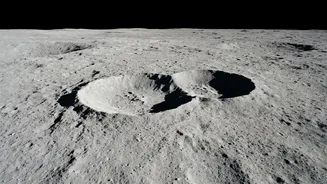
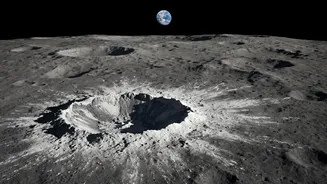
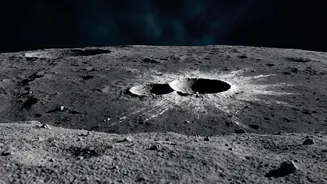
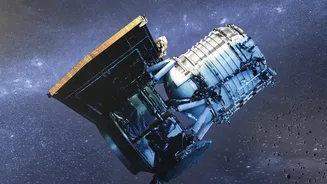
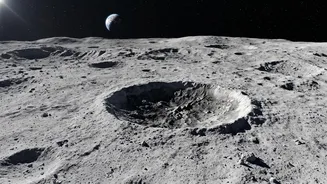
Following the impact, the hunt was on to find the crater. Since the crash happened on the far side, no one could observe it in real-time. The task fell to spacecraft already orbiting the Moon, chiefly NASA’s Lunar Reconnaissance Orbiter (LRO). The LRO is a workhorse of lunar science, equipped with powerful cameras that have been mapping the Moon in high detail for over a decade. In June 2022, the LRO team successfully located and imaged the impact site. What they found was surprising. Instead of a single, typical crater, the images showed a peculiar double crater, with two overlapping depressions creating an unusual shape. This unexpected feature suggested the impacting object was not a simple, uniform cylinder.
The Whodunit: A Case of Mistaken Identity
The strange double crater sent astronomers back to their calculations. The astronomer who first spotted the object, Bill Gray, announced a correction. After re-evaluating the data and receiving new information, he concluded the object was not from SpaceX at all. Instead, evidence pointed towards it being the booster stage from China’s Chang'e 5-T1 mission, launched back in 2014. An independent spectral analysis from the University of Arizona later supported this conclusion. The initial misidentification was an honest mistake, born from the challenge of tracking small, dark objects across vast distances without complete data from all space-faring nations. The Chinese Foreign Ministry, however, denied the object was from their mission, likely confusing it with the booster from the more recent Chang'e 5 mission, which had re-entered Earth's atmosphere.
What the Double Crater Tells Us
The double crater remains a subject of intrigue. Most spent rocket stages have a heavy engine at one end and a light, empty fuel tank at the other. This usually results in a single, asymmetric crater. The double impact suggests the Chang'e 5-T1 booster had a significant mass at both ends. Researchers speculate that the rocket may have been carrying an additional, un-declared piece of hardware or a heavy support structure for its primary payload. This 'mystery object' would have been massive enough to carve out its own crater upon impact. While not necessarily a secret payload, its presence highlights how little we sometimes know about the hardware journeying through our solar system.
A Crowded Sky, An Unclaimed Scar
This event has become a key example in the growing conversation about space debris and accountability. While the Moon is regularly hit by meteoroids, this was the first documented case of an unintentional impact by a piece of human-made junk. As more nations and private companies like SpaceX, Blue Origin, and others set their sights on the Moon, the number of objects—both active and defunct—in cislunar space is set to explode. The crash highlights the need for better tracking and international protocols for space traffic management. Unlike on Earth, there is no system to hold nations accountable for the hardware they leave behind, turning the Moon into a potential celestial junkyard. This unclaimed crater serves as a permanent, silent reminder of the new challenges we face in this new era of space exploration.