



Białowieża Forest, Poland and Belarus
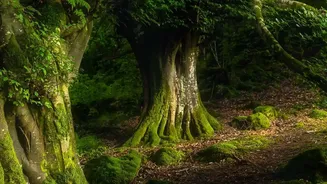
Step into what feels like a living fairy tale. Białowieża Forest is one of the last and largest remaining parts of the immense primeval forest that once stretched across the European Plain. This UNESCO World Heritage site is a time capsule of biodiversity,
home to ancient, towering trees and a sanctuary for over 800 European bison, the continent's heaviest land animal. The history of its protection dates back to the 14th and 15th centuries when Polish kings and Lithuanian grand dukes declared it a royal hunting ground. They established a refuge here, and the forest's name itself, meaning 'White Tower,' harks back to a wooden hunting manor. This royal patronage inadvertently preserved an ecosystem that has witnessed everything from plagues and Polish uprisings to the ravages of war. Walking among its ancient oaks, some named after the kings who once hunted here, you can feel the weight of both nature and history.
Plitvice Lakes National Park, Croatia
Famous for its 16 terraced lakes connected by a series of breathtaking waterfalls, Plitvice Lakes National Park is a spectacle of geology in motion. The vibrant turquoise and green waters flow over natural dams of travertine, a type of limestone that is continuously being deposited by the water, meaning the landscape is always changing. Officially founded as Croatia's first national park in 1949 and designated a UNESCO World Heritage site in 1979, its human story is just as dramatic. The area has been inhabited since prehistoric times, but its modern history is particularly poignant. The park was the site of the Plitvice Lakes incident in March 1991, one of the first armed confrontations of the Croatian War of Independence. Placed on the List of World Heritage in Danger during the conflict, it has since been restored and stands as a powerful symbol of nature's resilience and the nation's recovery.
Durmitor National Park, Montenegro
Durmitor is a land of dramatic extremes, carved by glaciers and underground rivers. It encompasses towering limestone peaks, deep canyons like the Tara River Canyon, and 18 glacial lakes known as 'mountain eyes'. While its natural splendor is undeniable, Durmitor also holds a unique historical treasure: mysterious medieval tombstones called stećci. Dating from the 12th to 16th centuries, these monolithic stone blocks are scattered across the landscape in necropolises, with two significant sites located within the park. Adorned with intricate carvings of hunting scenes, dances, and symbolic motifs, they offer a glimpse into the beliefs and culture of the region's medieval inhabitants, a mix of Christian and pre-Christian traditions. Recognized by UNESCO, these graveyards, set against a backdrop of wild mountain scenery, connect visitors directly to a past that is still shrouded in mystery.
Saxon Switzerland National Park, Germany
Straddling the border with the Czech Republic, Saxon Switzerland National Park is a landscape that seems born from a Romantic painting. Its defining features are the dramatic sandstone pillars, deep gorges, and rock formations rising from the forest floor. This unique landscape has inspired artists for centuries, most notably Caspar David Friedrich. The park was officially established in 1990, in the final months of the German Democratic Republic (GDR), linking it to the monumental political shifts of the late 20th century. Before that, early conservation efforts began in the early 1900s, and tourism blossomed with attractions like trolleybuses running through the park. Today, it forms a transboundary protected area with Bohemian Switzerland National Park in the Czech Republic, a testament to cross-border cooperation in preserving a shared natural and cultural heritage that was once divided by political lines.