

A Tale of Three Pairs
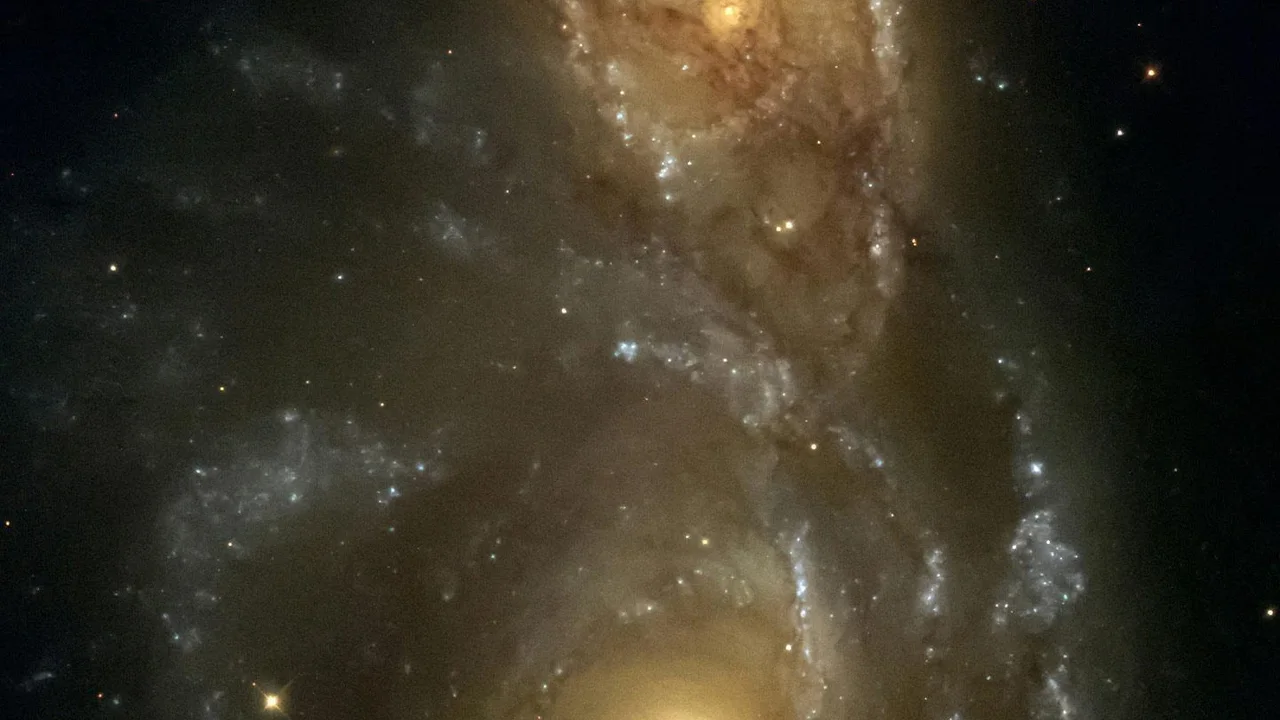
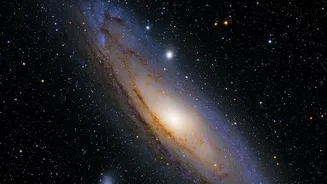
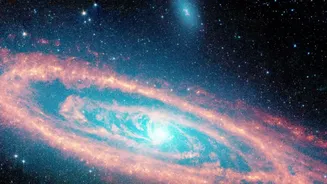
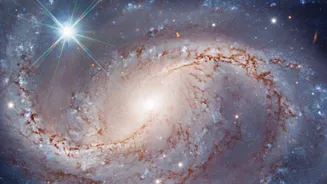
The image in question, highlighted as NASA's Astronomy Picture of the Day for August 10, 2026, presents a fascinating celestial lineup. Vertically arranged are three sets of paired galaxies, each telling a different story about proximity and interaction.
The bottom pair, NGC 4622A and NGC 4622B, are actively and gravitationally bound, distorting each other as they dance towards an eventual merger in perhaps a billion years. Moving up, the middle pair appears close, but their relative speeds suggest it's likely a coincidence—they are not interacting. At the top, the galaxies are also probably not interacting, though one, NGC 4650A, shows signs of a past collision with another, unseen galaxy. This single snapshot provides a perfect lesson: what looks like a duo might be a solo act and a distant illusion.
The Illusion of Flat Space
Telescope images, for all their splendor, are two-dimensional representations of a three-dimensional universe. This flattens depth, creating what astronomers call line-of-sight coincidences or chance alignments. Two galaxies can appear side-by-side in an image while being separated by hundreds of millions of light-years. It’s the universe’s grandest optical illusion. Think of it like seeing a photo of a person appearing to hold the moon in their hands; our brains know there’s a vast distance between them, but the 2D image makes them look connected. Astronomers face this challenge on a galactic scale, and they can't rely on simple visual cues to determine whether galaxies are a true interacting pair or just cosmic ships passing in the night.
The Astronomer's Measuring Tape
So, how do scientists tell the difference? The primary tool is measuring distance, and for that, they often turn to 'redshift'. As the universe expands, it stretches the light from distant objects to longer, redder wavelengths. By analyzing the spectrum of light from a galaxy, astronomers can measure its redshift and, by extension, calculate how far away it is and how fast it is moving away from us. If two galaxies that appear close together in an image have vastly different redshifts, it's a clear sign that one is much farther away than the other. They are a visual pair, not a physical one. This method is fundamental to mapping the true 3D structure of the cosmos.
Clues of a Cosmic Dance
Beyond redshift, astronomers hunt for physical evidence of interaction. When galaxies get truly close, their immense gravitational forces wreak havoc on each other. They pull and distort each other’s shapes, often creating long, wispy streamers of stars and gas called tidal tails. Sometimes, a bridge of material can be seen connecting the two, a tell-tale sign they are physically linked. In the NASA image, the bottom pair shows these signs of disturbance. In contrast, the middle and top pairs lack these clear gravitational signatures, reinforcing the idea that they are not currently interacting, even if they look like neighbors from our vantage point millions of light-years away on Earth. These visual clues, combined with redshift data, allow astronomers to piece together the true story behind the image.