


A New Class of Cosmic Giant
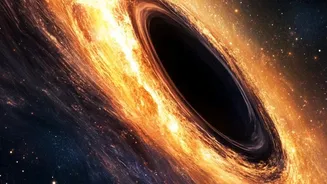
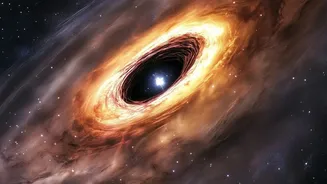
In the cosmic zoo of celestial objects, black holes are already the main event. We have stellar-mass black holes, born from the collapse of massive stars, and supermassive black holes (SMBHs), the giants that lurk in the centres of most galaxies, including
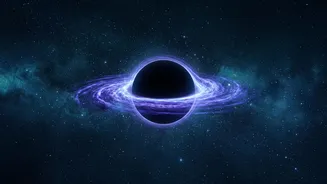
our own Milky Way. Sagittarius A*, our galaxy's central black hole, weighs about four million times the mass of our sun. The largest known SMBHs can reach tens of billions of solar masses. But recent theoretical work suggests there may be another, even more massive category: Stupendously Large Black Holes, or 'SLABs'. These are hypothetical behemoths with masses starting at 100 billion times that of the sun and potentially reaching far, far higher. Unlike the black holes we're familiar with, SLABs challenge our understanding of how cosmic structures can form and grow.
Born Before the Stars
So, how do you build a black hole of such epic proportions? The conventional methods don't seem to work. SMBHs are thought to grow by consuming stars and gas or by merging with other black holes. But this process has a natural speed limit; the universe simply isn't old enough for a black hole to 'eat' its way to 100 billion solar masses through these standard channels. Instead, scientists propose that SLABs could be 'primordial'—formed in the chaotic, dense conditions of the very early universe, even before the first stars and galaxies ignited. In those first moments after the Big Bang, massive fluctuations in density could have caused vast regions of matter to collapse directly into black holes. This primordial origin means they wouldn't be born from collapsing stars and could therefore possess a much wider range of initial masses, from tiny to, well, stupendously large.
Searching for Invisible Monsters
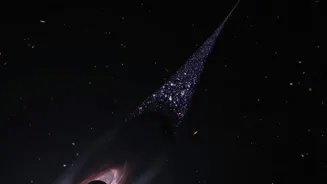
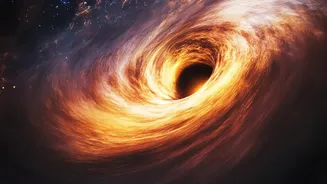
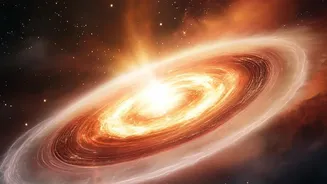
If SLABs exist, they are likely not where we find other black holes. Since they would have formed before galaxies, they could be wandering through the vast, empty voids of intergalactic space rather than sitting at a galaxy's core. This makes them incredibly difficult to find. We can't see black holes directly, but we detect them by their effects on their surroundings, like the bright, hot accretion disks of matter swirling into them. A lone SLAB in a cosmic void wouldn't have much to feed on, making it dark and silent. However, their immense gravity would still warp spacetime. One promising detection method is gravitational lensing, where the SLAB's gravity would bend and distort the light from distant background objects, creating multiple or warped images that our telescopes could spot. Another idea is that their immense shadows could be visible as 'negative sources' or cold spots against the faint, uniform glow of the cosmic microwave background radiation.
A Clue to Dark Matter?
The potential existence of SLABs has fascinating implications, particularly for one of the biggest mysteries in physics: dark matter. This unseen substance is thought to make up about 85% of the matter in the universe, providing the extra gravitational glue that holds galaxies together. For a time, primordial black holes of various sizes were considered a candidate for dark matter. While recent studies suggest that SLABs themselves are too massive and would be too 'grainy' to account for all dark matter, their discovery would lend huge support to the theory of primordial black holes in general. If SLABs can form in the early universe, then it becomes much more likely that smaller primordial black holes could have formed in vast numbers, potentially contributing to the dark matter we are searching for. In this way, finding just one of these giants could help solve a completely different cosmic puzzle.