





Imagine a vast, unending expanse of white salt that stretches to the horizon, glowing under the gentle morning sun or set ablaze with the fiery colours of dusk. This is the Rann of Kutch, the spectacular backdrop for Gujarat's Rann Utsav.
An Ocean of Salt
The Great Rann
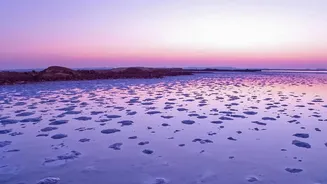
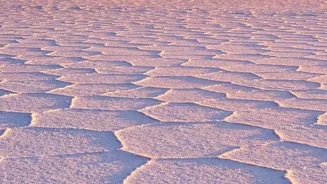
of Kutch is one of the largest salt deserts in the world, a remarkable landscape that remains submerged during the monsoon. As the water recedes from around October, it leaves behind a crust of pristine white salt that cracks into a stunning mosaic under the sun. This natural phenomenon creates a surreal, almost lunar-like canvas near the village of Dhordo, which becomes the hub for the annual Rann Utsav. The sheer flatness of the terrain provides an unobstructed, 360-degree view of the sky, making it a dream destination for photographers and nature lovers alike. The stark white ground acts as a giant reflector, amplifying the colours of the sky and creating a visual spectacle that is hard to find elsewhere.
The Serenity of Sunrise
Waking up before dawn at the Rann is an experience in itself. The air is crisp and cold, filled with a quiet anticipation. As the first light appears, around 7:00 AM to 7:30 AM during the festival season, the white desert transforms. The darkness gives way to soft pastel hues, painting the eastern sky in shades of pink, lavender, and gentle gold. The serene atmosphere, often with fewer crowds than in the evening, allows for a moment of peaceful reflection as the sun crests the horizon. The low-angle light catches the texture of the salt crystals, creating long, dramatic shadows and offering photographers a chance to capture the desert's tranquil morning mood. Some visitors describe it as one of the most moving travel experiences in India.
The Drama of Sunset
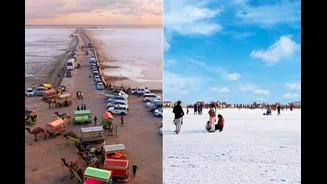
If the sunrise is a quiet meditation, the sunset is a grand theatrical performance. This is the more popular time for visitors, who gather to watch the daily show. As the sun begins its descent, typically between 6:00 PM and 6:30 PM, the sky explodes with vibrant shades of orange, red, and purple. Camel carts, carrying visitors to viewing points, become perfect silhouettes against the colourful sky, creating classic, postcard-worthy images. The entire landscape is bathed in a warm, dramatic glow that changes by the minute, before the final sliver of sun disappears, leaving a magical blue-hour twilight in its wake.
Beyond the Horizon: The Festival Experience
The Rann Utsav is more than just stunning views; it's a vibrant celebration of Kutchi culture. The festival's heart is the Tent City in Dhordo, a temporary settlement of comfortable Swiss cottages and tents that hosts thousands of visitors. The 2026–27 season is scheduled to run from November 1, 2026, to March 7, 2027. Evenings are filled with the sounds of folk music and the energy of traditional dance performances like Garba. Stalls and craft bazaars showcase the region's famed handicrafts, including intricate embroidery, Ajrakh block prints, and mirror work. Adventure seekers can also indulge in activities like ATV rides and camel safaris across the desert.
Planning Your Visit for the 2026–27 Season
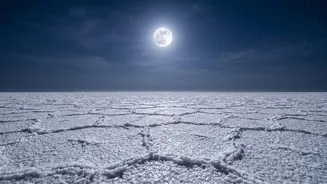
To make most of your trip,' planning ahead is key.' The festival dates for 'the '2026–27 season are officially from November '1,' '2026,' 'to March '7,' '2027.' The most popular,' 'and therefore most expensive,' 'times to visit are during full moon nights,' 'when 'the white salt desert glows ethereally under 'the moonlight.' Key full moon windows for this season are around November '23–25,' 'December '22–24,' 'January '21–23,' 'and February '19–21.' Bookings for 'the Tent City,' 'which often include meals and sightseeing,' 'should be made months in advance,' 'especially for peak periods like Diwali week (November '8–14)' 'and 'the Christmas–New Year period.' The nearest airport and major railway station are in Bhuj,' 'about '85 km from Dhordo,' 'with most packages offering transfers.' Remember to pack warm clothing,' 'as desert nights and early mornings can be surprisingly cold.