





A World of Constant Eruption
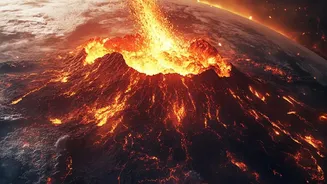
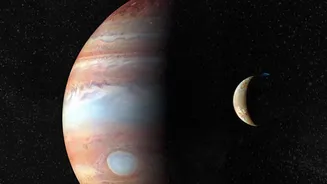
Imagine a world constantly churning, where hundreds of volcanoes spew fountains of lava miles into space. This isn't science fiction; it's Io, one of Jupiter’s largest moons. Its hellish landscape is a direct result of a gravitational tug-of-war. As Io orbits
the gas giant, it is relentlessly stretched and squeezed by Jupiter's immense gravity, as well as pulls from the neighboring moons Europa and Ganymede. This process, called tidal heating, generates tremendous internal heat, making Io far more volcanically active than Earth. For decades, scientists have studied this extreme world, but mostly by observing the heat escaping from its surface through infrared telescopes.
The Puzzle of the Smooth Plains
Despite its violent nature, Io presents a curious contradiction. While it boasts mountains taller than any on Earth, large portions of its surface are unexpectedly flat. Some of these smooth plains stretch for a hundred kilometers or more. If the moon is constantly being resurfaced by volcanic eruptions, why isn't the entire landscape a jagged mess? This question has puzzled planetary scientists. The new data suggests the surface we see is made of a very low-density material, more like fluffy volcanic ash or pumice than solid rock. This lightweight crust acts as a blanket, hiding the true story of what's happening just below.
Juno's Subsurface Peek
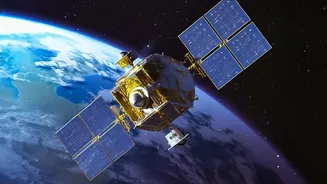
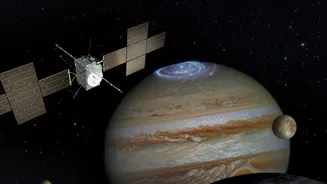
Enter NASA's Juno spacecraft. Originally designed to study Jupiter's deep atmosphere, the mission was extended to include close encounters with its Galilean moons. In late 2023 and early 2024, Juno flew within just 1,500 kilometers of Io's surface, a daring feat that provided an unprecedented look at the moon. The key was Juno's Microwave Radiometer (MWR) instrument. Unlike infrared instruments that only see the surface, the MWR can peer through the top layers of the crust, sensing temperatures several meters down. It was the first time scientists could directly measure the thermal profile beneath a rocky moon's surface, offering a new way to understand volcanic worlds.
A Blanket of Trapped Heat
The MWR data delivered a stunning revelation: it’s hot down there. Everywhere Juno looked, the temperature rose significantly just a few feet below the surface. The temperature gradient was far steeper than what could be explained by solar heating alone, confirming that the heat is coming from Io’s interior. The smooth, porous surface acts as an excellent insulator, trapping the immense heat generated by tidal forces. This means the serene-looking plains are a deceptive lid on a fiery oven. The findings suggest that either heat is steadily rising through the crust or that vast pockets of cooling lava are trapped just below the surface, covered by a thin layer of solidified material.
Solving the Mystery of Loki Patera
The new data also sheds light on one of Io’s most famous features: Loki Patera, a massive, 200-kilometer-long lava lake. Observations showed its surface is as smooth as glass in some areas, resembling obsidian on Earth. The MWR and other instruments helped confirm a long-held theory that Loki Patera's crust periodically becomes denser than the magma below it, causing it to sink and trigger a massive overturn, which explains its fluctuating temperatures over time. It’s not just a simple pool of magma, but a complex system with a dynamic crust. The presence of persistent islands, which have remained fixed for decades, challenges some models, suggesting they are anchored to the lake floor and resist the resurfacing waves.
Why This Discovery Matters
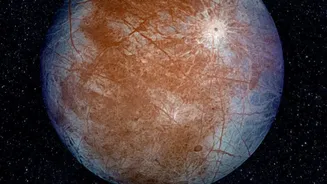
Understanding Io is about more than just one moon. The process of tidal heating is fundamental in the cosmos, potentially warming subsurface oceans on icy moons like Europa and Ganymede, which are prime candidates in the search for extraterrestrial life. By seeing how heat moves through Io's crust, scientists can refine their models for how this process works on other worlds. Furthermore, the surprising ability of the MWR to probe a rocky moon's subsurface has exciting implications for studying volcanism back on Earth. A similar instrument could one day give us new insights into the activity happening beneath terrestrial volcanoes.