





A 'Cosmic Flashlight' from the Early Universe
Astronomers are abuzz about a phenomenal event known as a Fast Radio Burst, or FRB. These are among the most enigmatic occurrences in the cosmos. They are incredibly intense flashes of radio waves that last for mere milliseconds but can release an astonishing
amount of energy in that fleeting moment—sometimes more than our sun produces in an entire year. First discovered in 2007, thousands of these bursts have been detected, but their origin remains one of astronomy's biggest mysteries. Recently, a particularly noteworthy burst, designated FRB 20240304B, was detected by the MeerKAT radio telescope in South Africa. What made this one special was its sheer distance. The signal travelled for more than 10 billion years to reach us, meaning it was unleashed when the universe was just 3 billion years old. This smashes the previous distance record for an FRB, making it a true messenger from our universe's distant past.
Webb Plays Cosmic Detective
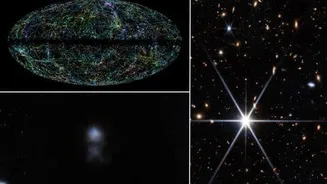
Detecting the burst is one thing; finding its home is another. The radio signal from FRB 20240304B was so faint and its location so distant that even the world's largest ground-based telescopes couldn't see a galaxy at its source. It looked like empty sky. This is where the unmatched power of the James Webb Space Telescope (JWST) came into play. With its incredible sensitivity to infrared light, Webb was able to peer into that patch of darkness and pinpoint the source. Sure enough, there it was: a very faint galaxy, previously invisible to us, was identified as the home of this record-shattering burst. Using its advanced instruments, Webb not only saw the galaxy but also measured its exact distance, confirming it was indeed the most distant FRB host ever found.
An Unlikely and Unexpected Home
The discovery of the host galaxy did more than just break a record; it added a fascinating twist to the mystery. Most FRBs previously traced to their source have come from large, mature galaxies. However, Webb revealed that the host of FRB 20240304B is a small, metal-poor dwarf galaxy. It’s a young galaxy, actively forming new stars at a high rate. This finding was completely unexpected and runs counter to some leading theories about what causes these epic bursts. One prominent theory suggests FRBs could be caused by the violent merger of two neutron stars. But such events take a long time, often over a billion years, and are therefore more likely to occur in older, more massive galaxies. This burst coming from a young, small galaxy challenges that idea.
Strengthening the Magnetar Theory
So, if not a merger, then what? The unexpected nature of the host galaxy lends significant weight to another leading hypothesis: magnetars. A magnetar is a type of young, rapidly spinning neutron star with an incredibly powerful magnetic field—the strongest in the universe. These extreme objects are thought to be born from massive stars that go supernova. Since the host galaxy is a hotbed of new star formation, it's precisely the kind of environment where you'd expect to find young magnetars. The discovery that this record-breaking FRB came from such a place makes the magnetar explanation more plausible than ever, suggesting that these cosmic powerhouses can form and start producing bursts relatively early in a galaxy's life. While the cause is not yet confirmed, this finding provides a crucial clue. For now, the universe’s most powerful explosions continue to keep scientists on their toes, revealing that even the smallest corners of the cosmos can hide the biggest secrets.