







What Is E20 Fuel?
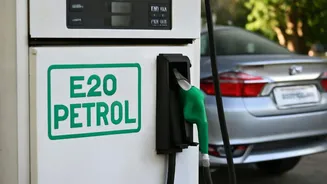
E20 is a blend of 80% petrol and 20% ethanol, an alcohol-based fuel produced from agricultural sources like sugarcane and maize. India has rapidly adopted this blend as part of its Ethanol Blended Petrol (EBP) Programme. The goals are threefold: to reduce
the country's massive oil import bill, lower vehicle emissions, and provide an additional source of income for farmers. Having successfully rolled out E10 (10% ethanol), the government fast-tracked its target for nationwide E20 availability, achieving the goal in 2025-26, years ahead of the original 2030 schedule.
Decoding the New 2-6% Efficiency Range
The core of the new announcement is the official acknowledgement of how E20 affects mileage. In a statement to Parliament, the Ministry of Road Transport and Highways confirmed that using E20 can lead to a fuel efficiency loss of 2% to 6%. This isn't a surprise to engineers; ethanol has a lower energy density than petrol, meaning you need to burn slightly more fuel to travel the same distance. What's new is the government providing a specific, wider range. Previously, the Petroleum Ministry had mentioned a tighter 3-5% drop. This new, broader 2-6% range offers a more realistic and flexible benchmark that accounts for different types of vehicles, their age, and the engine technology used.
Why This Clarity Matters for Automakers
This wider efficiency range provides much-needed clarity for the automobile industry. While carmakers have been producing E20-compliant vehicles since 2023, the official efficiency parameters were less defined. Acknowledging a range of up to 6% gives manufacturers a more practical target for testing and certifying their vehicles. It allows them to design and tune engines that can operate efficiently within this known trade-off. Durability tests conducted on E20 fuel have not shown significant engine failures, and major manufacturers have reported no increase in corrosion or abnormal wear in vehicles they have serviced. This official range helps align consumer expectations with engineering reality.
What It Means for Your Fuel Budget
For the average driver, this means accepting a small hit to your vehicle's mileage as a trade-off for the country's larger energy goals. A 2-6% drop is noticeable but may not be drastic. For a car that typically delivers 15 km/l, a 6% drop would reduce its mileage to about 14.1 km/l. While modern E20-compliant cars are designed to handle this with minimal impact, older vehicles might experience a more significant drop, sometimes reported by drivers to be as high as 10-15%. It is important to remember that mileage is also affected by driving style, traffic conditions, and vehicle maintenance. The government has argued that while E20 may not be cheaper at the pump, its main benefit is price stability and reducing dependence on volatile global oil markets.
The Bigger Picture: Energy Security vs. Mileage
The government's push for ethanol blending is a strategic long-term play. India is one of the world's largest oil importers, and this dependency leaves the economy vulnerable to global price shocks and geopolitical instability. By substituting a portion of imported crude oil with domestically produced ethanol, India saves billions in foreign exchange, reduces its carbon footprint, and supports its agricultural sector. The small dip in fuel efficiency for individual drivers is presented as a collective contribution toward achieving these larger national objectives of energy security and environmental responsibility. The new efficiency range is the government's way of making the terms of this trade-off clear for everyone.