





A Mission Cut Short
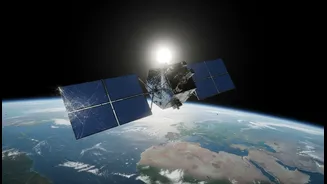
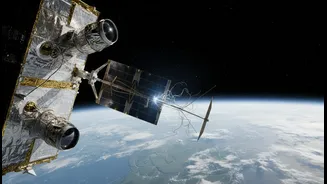
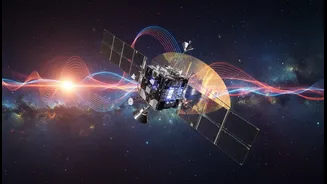
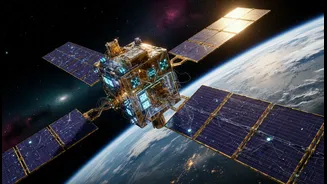
In early July, Bengaluru-based space-tech startup GalaxEye announced that it had lost contact with its maiden satellite, Mission Drishti. Launched in May aboard a SpaceX rocket, the 190 kg spacecraft was a major milestone for India's private space sector.
It was designed to be the world's first satellite to combine high-resolution optical cameras with all-weather Synthetic Aperture Radar (SAR), allowing it to see through clouds and darkness. However, during its early orbit phase, the satellite encountered a severe geomagnetic storm. The company's analysis suggests that extreme radiation from the storm compromised a critical onboard system, leading to a complete loss of communication. While recovery is deemed unlikely, the event provides a costly, real-world lesson on the hazards of our increasingly active Sun.
What Is Space Weather?
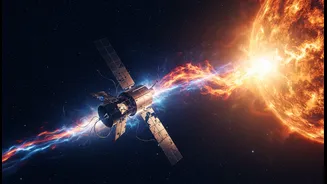
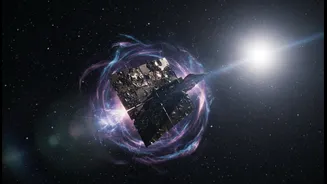
Space weather refers to the changing conditions in space driven by the Sun's activity. The Sun constantly releases a stream of charged particles called the solar wind. Sometimes, it also has much more violent outbursts, such as solar flares (intense bursts of radiation) and coronal mass ejections, or CMEs (massive clouds of solar plasma and magnetic fields hurled into space). When these events are aimed at Earth, they can interact with our planet's magnetic field and upper atmosphere, causing what's known as a geomagnetic storm. These storms are responsible for the beautiful auroras, but they also pack a punch that can be devastating for technology.
How Storms Kill Satellites
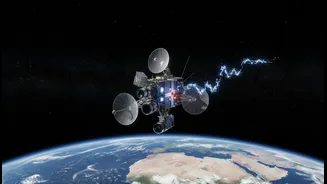
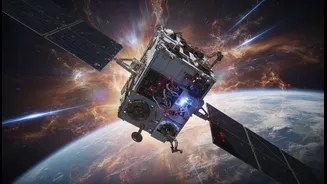
Geomagnetic storms threaten satellites in two primary ways. The first is through radiation. High-energy particles from a solar flare or CME can bombard a satellite, damaging its sensitive electronics, degrading its solar panels, or confusing its software. This appears to be the cause of Mission Drishti's failure. The second, more common threat for satellites in Low Earth Orbit (LEO) is atmospheric drag. During a geomagnetic storm, the energy dumped into Earth's upper atmosphere causes it to heat up and expand, like a balloon. This increases the density of the air, even hundreds of kilometres up. Satellites flying through this suddenly thicker atmosphere experience significantly more drag, which slows them down and causes their orbits to decay. If the satellite cannot fire its thrusters to climb back up, it will eventually fall back to Earth and burn up. This is what happened to a batch of nearly 40 SpaceX Starlink satellites in February 2022, a watershed moment for the industry.
A Growing and Crowded Risk
The problem of space weather is becoming more urgent for two reasons. First, the Sun is entering a period of higher activity in its natural 11-year cycle, meaning more frequent and intense storms are expected. Second, our reliance on space infrastructure has never been greater. LEO is now crowded with thousands of satellites forming mega-constellations for internet (like Starlink), Earth observation, and more. Each of these satellites is a potential victim. The sheer number of identical satellites in some constellations also creates a systemic risk; a single storm could potentially disable a significant portion of a network. As we depend on satellites for everything from GPS navigation and financial transactions to disaster management and defence, the economic and societal stakes are enormous.
Forecasting the Future
Just as we have weather forecasts on Earth, a growing field of science is dedicated to predicting space weather. Agencies like the U.S. National Oceanic and Atmospheric Administration (NOAA) monitor the Sun and provide warnings of incoming solar storms. These forecasts can give satellite operators precious hours to prepare, whether by putting spacecraft into a protective safe mode, reorienting them to minimize drag, or postponing maneuvers. Following its loss, GalaxEye announced it would bring more manufacturing in-house to build more resilient spacecraft for the future. The loss of Mission Drishti, while a setback, underscores a critical message for the entire space industry: success in space is no longer just about building and launching satellites, but about ensuring they can survive the cosmic weather.