
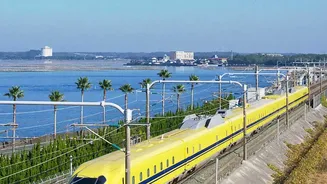

A Landmark Trial on the Horizon
According to recent announcements by Union Railway Minister Ashwini Vaishnaw, the country's first indigenously-built high-speed train is set to hit the tracks for testing between May and June 2027. This crucial phase will take place on a nearly complete
section of the 508-kilometre corridor. The first body frame of the bullet train has already been completed and sent for structural integrity tests, a significant step under the 'Atmanirbhar Bharat' initiative. Following a testing period of two to four months, the first section of the line is expected to be inaugurated and opened to the public. This phased rollout will begin with the Surat-Bilimora section in Gujarat, with other segments to follow as construction is completed.
Gujarat Races Ahead
The Gujarat portion of the project has seen remarkable progress, making it the focal point for the initial launch. Work on sections like Surat-Vapi is slated for completion by the end of this year. Construction of viaducts, the elevated structures that carry the tracks, has moved rapidly, with hundreds of kilometres of piers and girders already in place. Stations in major Gujarat cities like Ahmedabad, Vadodara, and Surat are in advanced stages of construction, designed as multimodal hubs to connect seamlessly with local transport. The rapid pace in Gujarat is why the state will host the first operational stretches of the bullet train, with the initial service between Surat and Bilimora set to launch by August 2027.
Maharashtra: Overcoming Delays
While Gujarat has surged ahead, the Maharashtra section has historically faced significant hurdles, primarily related to land acquisition and environmental clearances. These challenges led to initial project delays and cost overruns. However, recent progress has been swift. Construction is now actively underway on the 135-kilometre stretch in Maharashtra, with work on elevated stations at Thane, Virar, and Boisar picking up speed. A key engineering feat in this section is India's first undersea rail tunnel. This 21-kilometre tunnel, including a 7-kilometre portion under Thane Creek, is a complex part of the project connecting to the terminal station at Bandra Kurla Complex in Mumbai. With breakthroughs achieved in several mountain tunnels and work progressing on major river bridges, the Maharashtra leg is now catching up.
The Tech Behind the Speed
The Mumbai-Ahmedabad corridor is being built with Japan's renowned Shinkansen technology, known globally for its exceptional safety and reliability. The trains are designed to operate at a speed of 320 km/h, drastically cutting travel time. The journey between Mumbai and Ahmedabad, which currently takes over six hours by the fastest trains, will be reduced to just under two hours with limited stops. The project utilizes advanced construction techniques and features like J-Slab ballastless tracks, which are crucial for maintaining stability at high speeds. While the core technology is Japanese, the train sets themselves are being manufactured indigenously, representing a significant transfer of technology and a boost for domestic manufacturing.
What This Means for India
The bullet train is more than just a fast mode of transport; it's a catalyst for economic growth and a symbol of India's infrastructural ambition. The corridor connects two major economic hubs, promising to enhance business, tourism, and employment opportunities along its route. By providing a faster, safer, and more reliable alternative to road and conventional rail, it is expected to decongest existing networks and reduce pollution. Furthermore, the Mumbai-Ahmedabad project is serving as a blueprint for a larger network of high-speed rail corridors planned across the country. The standards and practices developed here will help accelerate the execution of future projects, paving the way for a new era in Indian mobility.