




Meet MANTIS, the Stellar Sidekick
NASA's new mission is a compact but powerful space telescope called MANTIS, which stands for Monitoring Activity from Nearby sTars with uv Imaging and Spectroscopy. Scheduled for a 2026 launch, this small satellite, about the size of a toaster oven, has
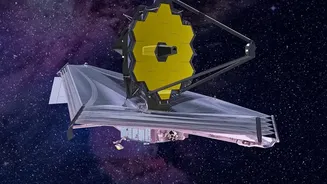
a huge job: to act as a sidekick to the mighty James Webb Space Telescope (JWST). While Webb excels at peering into the atmospheres of distant planets, MANTIS will keep its eyes fixed on their parent stars. The mission, developed by the University of Colorado Boulder, is designed to give scientists the missing piece of the puzzle. By understanding the star, we can finally get a clear picture of the planet.
Why a Star's Mood Matters
Finding a rocky planet at the right distance from its star is just the first step. Scientists now realize that a star’s temperament is one of the most critical factors for life. Many stars, particularly the common red dwarfs, are incredibly volatile. They can unleash powerful stellar flares and blasts of high-energy ultraviolet (UV) radiation that are far more intense than anything our sun produces. For a planet orbiting nearby, this radiation can be a death sentence. It can strip away a planet’s atmosphere, boil off its surface water, and effectively sterilize the world before life even has a chance to begin. A planet might be in the perfect location to support liquid water, but if it is constantly being bombarded by its star, it's less of a habitable world and more of a cosmic shooting gallery.
The Ultraviolet Blind Spot
A major challenge in assessing these stellar threats is that the most dangerous radiation is invisible to us from Earth. Our planet's atmosphere conveniently blocks most extreme ultraviolet (EUV) light, which is great for life on Earth but a problem for astronomers. This is the specific type of energy that can wreak havoc on a budding planetary atmosphere. MANTIS is designed to fill this observational gap. It is equipped with two telescopes that can observe the full spectrum of UV and EUV light, something no mission has been able to do for stars other than our own sun in over two decades. For many of its target stars, MANTIS will provide the first-ever measurements of their high-energy output, giving scientists crucial data on the true conditions a nearby planet must endure.
Redefining the Habitable Zone
The MANTIS mission will help redefine the very concept of a “habitable zone.” For years, this has been a relatively simple calculation based on the distance from a star where water could be liquid. But MANTIS will add a vital new variable: stellar hostility. A star’s flare activity and UV radiation levels create a “habitable zone” that is not just about temperature, but about safety. This mission will allow astronomers to create a more sophisticated checklist for identifying potentially life-bearing worlds. They will be able to cross-reference Webb’s atmospheric data on a planet with MANTIS’s data on its star’s violent outbursts. This combined approach will help filter out the planets that look promising on the surface but are ultimately located in unsurvivable environments, saving valuable observation time for more truly promising candidates.