








An Unprecedented Production Milestone
Mahindra & Mahindra's state-of-the-art manufacturing facility in Chakan, Maharashtra, recently announced it had crossed a cumulative production milestone of three million vehicles. While the total number is impressive, the truly remarkable story lies
in the speed of the latest achievement. The facility took 107 months to build its first million vehicles, but the most recent million rolled off the assembly line in a mere 27 months. This dramatic acceleration, nearly four times faster than its initial pace, is not just a result of increased demand but a direct consequence of a strategic embrace of digital manufacturing and Industry 4.0 principles. The milestone vehicle, a Mahindra BE 6 electric SUV, signals that this fusion of technology and manufacturing is central to the company's future in both traditional and electric mobility.
The 'Smart Factory' in Action
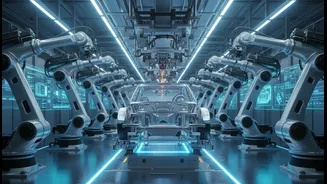
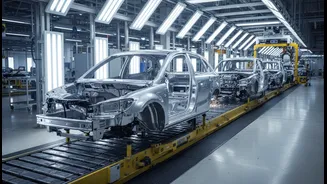
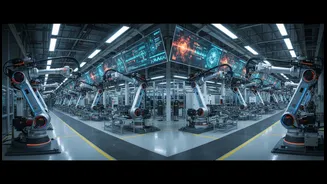
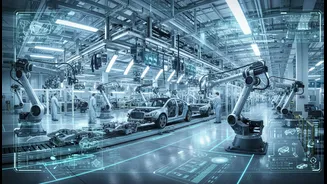
So, how did they do it? The answer lies in transforming the Chakan plant into a 'smart factory'. This wasn't about simply adding more assembly lines; it was about making every process more intelligent, connected, and efficient. At the core of this transformation are technologies like Artificial Intelligence (AI), the Internet of Things (IoT), and advanced robotics. For instance, the body shop boasts a staggering 98% automation rate, with around 1,500 robots performing complex welding and assembly tasks with precision and speed that human hands cannot match. This high level of automation is a cornerstone of the plant's ability to scale up production so rapidly.
Data-Driven Quality and Efficiency
Digital manufacturing is also about using data to perfect the end product. At the Chakan facility, quality control is no longer just a final inspection. Technologies like 3D component scanning and real-time weld-integrity monitoring ensure that every part meets exact specifications from the very beginning. The plant employs a 'No Fault Forward' system, where automated quality gateways prevent any component with a defect from moving to the next stage of production. Furthermore, AI-driven monitoring systems track everything from production flow to worker safety, using data to predict potential bottlenecks or hazards before they occur. This data-centric approach minimizes errors, reduces waste, and contributes significantly to the accelerated production timeline.
Flexibility for a Diverse Market
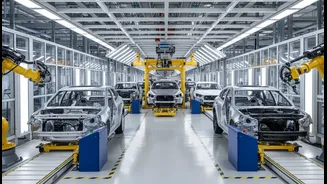
One of the most significant advantages of this digital setup is manufacturing flexibility. The 657-acre Chakan hub is not a one-trick pony; it produces 19 different models and over 450 variants, encompassing internal combustion engine (ICE) cars, commercial vehicles, and the latest electric vehicles. This is possible because the assembly lines are designed to be flexible, capable of handling multiple vehicle architectures simultaneously. This agility allows Mahindra to quickly adapt to shifting market demands, a crucial capability in today's fast-evolving automotive landscape. This advanced setup doesn't just serve the domestic market; the plant is a critical export hub, shipping vehicles to global markets like Australia, New Zealand, and South Africa.