

The Ultimate High-Stakes Mission
When we talk about “acting” on an asteroid, we’re generally referring to two major goals: planetary defense or resource extraction. The first involves changing an asteroid’s trajectory to prevent a potential collision with Earth. NASA’s DART (Double Asteroid
Redirection Test) mission in 2022 was a spectacular proof of this concept, successfully altering the orbit of the asteroid moonlet Dimorphos by crashing a spacecraft into it. The second goal, asteroid mining, remains in the realm of science fiction for now, but commercial entities are seriously exploring the possibility of harvesting valuable minerals from these celestial bodies. Both endeavors, however, depend on a fundamental understanding of the target. An asteroid isn't just a point in space; it's a physical object with properties that can make or break a multi-billion dollar mission.
Shape: More Than Just a Rock
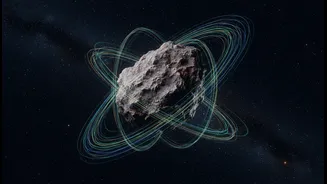
Unlike planets, which are massive enough for their own gravity to pull them into spheres, most asteroids are small, lumpy, and irregularly shaped. This irregularity has profound consequences. An asteroid's gravitational field is not uniform; it's lumpy, just like the asteroid itself. This creates complex and unpredictable gravitational pulls on any spacecraft attempting to orbit or land. Furthermore, many asteroids are not solid, monolithic rocks but are instead “rubble piles”—loose collections of gravel and boulders held together by their own weak gravity. Missions like OSIRIS-REx to the asteroid Bennu discovered a surface far rockier and more loosely consolidated than expected, which posed significant challenges for collecting a sample. Trying to push or land on a rubble pile without understanding its structure is like trying to push a beanbag; the energy gets absorbed in unpredictable ways, making the outcome difficult to control.
Rotation: A Cosmic Spinning Top
In addition to their odd shapes, asteroids also spin. Some rotate slowly and predictably, while others tumble chaotically through space. This rotation is a critical factor for any mission. Attempting to land on a fast-spinning or tumbling asteroid is a navigational nightmare. The rotation also affects the asteroid's surface. A fast spin can create enough centrifugal force to fling loose material off the surface, which is exactly what OSIRIS-REx was designed to collect. Therefore, mission planners prefer slower-rotating targets. The DART mission had to autonomously target a specific point on Dimorphos while both were moving at kilometres per second, a feat made possible only by extensive prior analysis of the binary system's orbit and rotation.
The Combined Complication: Shape and Spin Together
The real challenge is that shape and rotation are not independent variables; they are deeply intertwined. An asteroid's irregular shape affects its rotation. As it tumbles through space, sunlight reflecting off its surface and heat radiating away creates a tiny, but relentless, push. Over millions of years, this phenomenon, known as the YORP effect, can cause an asteroid to spin faster or slower, and can even change its axis of rotation. An irregularly shaped asteroid acts like a tiny, solar-powered windmill. This means the asteroid's spin rate isn't necessarily constant. It might be gradually speeding up to the point where it could break itself apart, flinging its constituent rubble into space. This dynamic interplay makes predicting an asteroid's future state incredibly complex. A kinetic impact meant to nudge an asteroid could have a wildly different effect depending on where you hit it, its composition, and its specific rotational state at that moment.
Reading the Celestial Clues
So, how do scientists analyse these properties from millions of kilometres away? They use a combination of powerful Earth-based and space telescopes. By observing how the light reflected from an asteroid changes over time—its light curve—astronomers can deduce its rotation period and get a rough idea of its shape. Radar observations provide more detailed 3D models of the asteroid's shape and can help determine if it has any moons. Missions like DART and OSIRIS-REx perform detailed surveys upon arrival, mapping the surface in high resolution and precisely measuring the asteroid's mass and gravitational field before attempting any physical interaction. This preliminary analysis is not optional; it's the foundation upon which mission success is built.