






A Planetary Weather Report
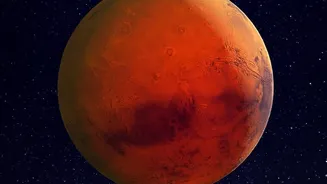
In a significant leap for planetary science, researchers from the Physical Research Laboratory (PRL) in Ahmedabad have charted the dramatic climate of Mars with unprecedented detail. Their study, published in the journal Current Science, details extreme
temperature fluctuations on the Martian surface, swinging from a relatively mild 27 degrees Celsius in the summer to a frigid -113 degrees Celsius in winter. These wild swings are largely due to Mars's incredibly thin atmosphere, which is about 100 times less dense than Earth's. Without a thick atmospheric blanket to trap and circulate heat, the planet's surface warms up rapidly under the sun and loses that heat just as quickly when night falls.
The Eye in the Martian Sky
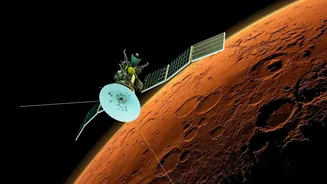
This detailed analysis was made possible by the Emirates Mars Mission, also known as the Hope probe. Unlike previous missions that could only capture snapshots of Martian weather at certain times of day, the Hope probe has a unique, wide orbit. This allows its instruments, particularly the Emirates Mars Infrared Spectrometer (EMIRS), to scan the entire planet multiple times a day. This comprehensive, gap-free data provided the Indian research team with a continuous stream of thermal observations, allowing them to create a global map of how temperatures rise and fall not just with the seasons, but throughout each Martian day. The collaboration highlights a modern approach to space science, where data from one nation's mission empowers scientists in another to make groundbreaking discoveries.
Decoding Mars' Atmospheric Dance
Perhaps the most fascinating part of the discovery is the identification of large-scale, wave-like temperature patterns, known as zonal waves. Think of them like ripples on a pond, but instead of water, they are massive waves of temperature rippling through the thin Martian atmosphere. These are not random fluctuations; they are structured patterns that travel around the planet. The PRL scientists focused on two massive impact basins, Hellas and Argyre, and found that the shape and size of these craters significantly influence the waves. For example, the Argyre basin was dominated by a simple, single-wave pattern (wave-1), while the deeper Hellas basin showed more complex wave-2 and wave-3 patterns that changed with the seasons. These waves are a vital clue, offering an indirect window into how Mars's atmosphere circulates energy and heat across its surface.
The Ahmedabad Connection
This pioneering research was led by a team of scientists at Ahmedabad's prestigious Physical Research Laboratory, reinforcing India's growing legacy in planetary exploration. The study builds on the expertise developed during India's own historic Mars Orbiter Mission (Mangalyaan), which significantly contributed to our understanding of the Martian atmosphere. The PRL team's ability to leverage data from an international mission like Hope demonstrates the high calibre of Indian scientific analysis and its key role in the global quest to understand our solar system. By comparing the Hope data with existing climate models, the scientists also found that the models were often about 10 degrees Celsius cooler than the actual measurements, highlighting the importance of real-world observation in refining our predictions.
Why This Changes Our View of Mars
Understanding Mars's weather is not just an academic exercise. A precise map of its temperature swings and atmospheric dynamics is critical for the future of Mars exploration. For any future robotic or human missions, knowing the extreme temperature changes and atmospheric behaviour is essential for designing landers, habitats, and equipment that can survive the harsh environment. Furthermore, this research helps piece together the puzzle of Mars's past. By understanding how the atmosphere behaves today, scientists can build better models to figure out how Mars lost its once-thicker atmosphere and liquid water. It's a crucial step in answering the ultimate question: could life have ever existed on the Red Planet?