





The Cosmic Disappearing Act
Imagine spending years observing a colossal, brilliant star, many times the mass of our own sun, only for it to suddenly wink out of existence. This isn't science fiction; it's a real cosmic puzzle that has stumped astronomers. For decades, our understanding
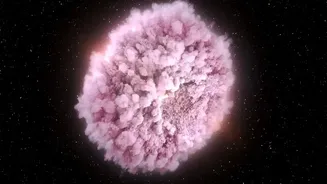
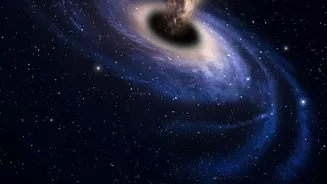
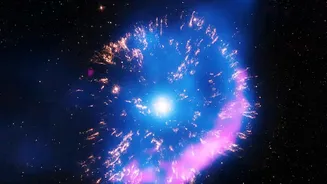
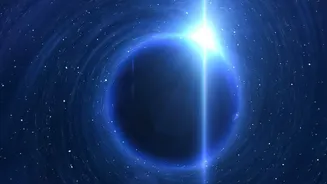
of stellar evolution has told us that when a massive star exhausts its fuel, its core collapses under its own immense gravity, triggering a cataclysmic explosion known as a supernova. These explosions are among the most energetic events in the universe, briefly outshining entire galaxies. Yet, astronomers have noticed a strange discrepancy: there are fewer observed supernovae than our theories predict. This has led to the idea of a “failed supernova,” an event where a star massive enough to explode instead collapses quietly, leaving behind a black hole without the expected fanfare.
Introducing the Ghost Particle
To solve this mystery, scientists have turned their attention to one of the universe's strangest and most abundant particles: the neutrino. Often called “ghost particles,” neutrinos are almost massless, have no electric charge, and barely interact with other matter. Trillions of them stream through your body every second without you ever noticing. During the core collapse of a massive star, an almost unimaginable number of neutrinos are created, carrying away about 99% of the stupendous energy released. In a successful supernova, these neutrinos play a crucial role. As they blast outward from the core, a small fraction of them slam into the surrounding stellar material, heating it up and providing the critical push needed to revive the stalled shockwave and blow the star apart.
A Change of Flavor, A Change of Fate
Recent research, particularly from a team at the University of Copenhagen, has revealed a new wrinkle in this process. Neutrinos come in three different types, or “flavors”: electron, muon, and tau. They can also rapidly switch between these flavors. A new study published in Physical Review D suggests that this flavor-switching, previously thought to be a minor detail, may be the deciding factor in a star's final moments. The simulations, which modeled stars between 9 and 120 times the mass of the sun, found that including neutrino flavor conversions had a dramatic effect. For a significant number of stars, particularly those between 16 and 30 times the mass of our sun, this flavor-switching changes how the neutrinos interact with the material around the core. Instead of depositing enough energy to trigger an explosion, the energy is carried away more efficiently, robbing the shockwave of its power. The explosion fails, and the star collapses directly into a black hole.
Solving a Universal Mystery from Afar
This finding could elegantly explain the 'supernova rate problem'—the long-standing mystery of the missing explosions. If many massive stars are indeed fizzling out rather than blowing up, it would account for the discrepancy between theoretical models and what astronomers observe. Crucially, this research is about understanding the fundamental physics of the cosmos, not predicting any local danger. The stars undergoing these processes are millions of light-years away, and the neutrinos they release stream harmlessly through our planet and everything on it. The discovery provides a powerful new tool for understanding the lifecycle of stars and the birth of black holes. As one researcher noted, studying these failed supernovae might be the only feasible way of actually witnessing a black hole being formed.