




A New Eye on the Cosmos
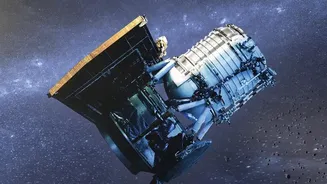
Following the incredible success of the Hubble and James Webb Space Telescopes, NASA has launched its next flagship observatory. Named after Dr. Nancy Grace Roman, NASA's first chief of astronomy and the “Mother of Hubble,” the Roman Space Telescope launched in August
2026. While it has a primary mirror the same size as Hubble's at 2.4 meters, its purpose is fundamentally different. It’s not about staring intently at a single, tiny patch of sky for days on end. Instead, Roman is a grand surveyor, built to scan huge swathes of the universe quickly and efficiently, creating panoramic cosmic maps of unprecedented scale. The “questions” raised by its design are not about flaws, but rather the profound scientific mysteries it is poised to solve.
Seeing the Bigger Picture
The key to Roman’s power is its Wide Field Instrument (WFI), a 300.8-megapixel camera that gives it a truly colossal field of view. To put it in perspective, Roman’s view is at least 100 times larger than Hubble’s and 200 times larger than Hubble's infrared instrument. Imagine looking at the night sky. If Hubble is like peering through a drinking straw, seeing one star with incredible clarity, Roman is like looking through a massive panoramic window, capturing thousands of stars and entire galaxies in a single glance. Where it might take Hubble hundreds of individual images to map a certain area, Roman could do it in just a couple. This ability to capture vast amounts of data with Hubble-like sharpness is what makes Roman a game-changer for astronomy.
Unraveling a Dark Universe
Two of the biggest puzzles in modern physics are dark energy and dark matter. Scientists believe dark energy is the mysterious force causing the universe's expansion to accelerate, while dark matter is the unseen cosmic glue holding galaxies together. Together, they make up about 95% of the universe, but we know almost nothing about them. To study them, you need a huge statistical sample—observations of millions, or even billions, of galaxies across cosmic time. This is where Roman’s wide-field view becomes essential. By surveying the sky, it will map the distribution of galaxies and measure their distances using several techniques, including observing supernovae and weak gravitational lensing. This will allow scientists to trace the history of cosmic expansion and the growth of structures in the universe, providing crucial clues about the true nature of these dark components.
A Census of Distant Worlds
Beyond cosmology, Roman is set to revolutionize the hunt for exoplanets—planets orbiting other stars. While missions like Kepler and TESS have been incredibly successful, they primarily find planets that orbit very close to their stars. Roman will use a different technique called gravitational microlensing. This method can detect planets at much greater distances from their star, including free-floating planets that have been ejected from their systems. Because these microlensing events are rare and unpredictable, a telescope needs to monitor millions of stars at once to catch them—a perfect job for Roman's panoramic gaze. It's expected that Roman could discover tens of thousands, or even up to 100,000 new exoplanets, creating a statistical census that will tell us how common planets like Earth really are in our galaxy.