


The Illusion of Local Rain
We learn the water cycle in school: water evaporates, forms clouds, and falls as rain. It seems simple and, above all, local. The assumption is that the water from a nearby river or the coastline is what feeds the clouds overhead. While local evaporation
certainly contributes, it is often a surprisingly small part of the picture. Studies on 'moisture recycling' show that for a given area, the vast majority of rainfall originates from water that evaporated somewhere else. In fact, only about 10 percent of the water that evaporates from the vast oceans is transported over land to fall as precipitation. A single water molecule, once evaporated, spends an average of about nine or ten days in the atmosphere, carried by global wind patterns, before it falls back to Earth. This means the water in a puddle after a storm could have journeyed from a distant ocean or a forest on another continent.
Rivers in the Sky
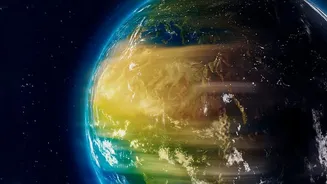
The mechanism behind this long-distance water travel is a phenomenon known as 'atmospheric rivers'. These are long, narrow corridors of concentrated water vapour flowing in the sky, much like a river on the ground. These atmospheric rivers can be thousands of kilometres long and carry an immense amount of moisture—sometimes equivalent to many times the flow of a major river like the Mississippi or the Amazon. They are responsible for about 90% of the movement of moisture from the warm tropics toward the cooler poles. These invisible rivers are guided by high-altitude jet streams and other large-scale weather patterns. When they make landfall, often forced upward by mountain ranges, the water vapour cools, condenses, and falls as heavy rain or snow. This process is vital, responsible for more than half the rainfall in some coastal regions around the world.
Tracing India's Monsoon
This global perspective is crucial for understanding India’s lifeline: the monsoon. The Indian summer monsoon is a dramatic example of long-distance moisture transport. The process begins with the intense heating of the Indian subcontinent during summer, which creates a low-pressure area. This draws in massive amounts of moisture-laden air from the high-pressure zones over the cooler Indian Ocean, Arabian Sea, and Bay of Bengal. These winds, loaded with evaporated water from thousands of square kilometres of ocean surface, travel towards the land. The southwest monsoon splits into two main branches—the Arabian Sea branch and the Bay of Bengal branch—which bring rain to different parts of the country. As these winds encounter the Western Ghats and the Himalayas, they are forced to rise, cool, and release their vast water content, delivering 70-90% of India's annual rainfall.
A Globally Connected Water Cycle
Recognizing that rain is not purely a local event has profound implications. It means that land-use changes in one part of the world, like deforestation, can affect evaporation patterns and reduce rainfall hundreds or thousands of kilometres downwind. A recent study noted that as the world warms, atmospheric moisture is already travelling farther before it falls as rain. This interconnectedness highlights our shared vulnerability and responsibility. Water security for a nation may depend on the environmental stewardship of its neighbours, and even countries on distant continents. It transforms our understanding of the water cycle from a simple loop into a vast, complex, and global web of connections. Protecting forests in one region or managing ocean temperatures is no longer just a local issue; it’s a critical part of maintaining the planetary system that delivers life-giving rain to us all.