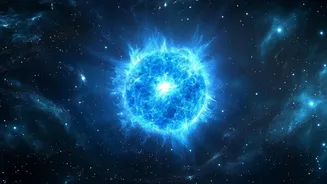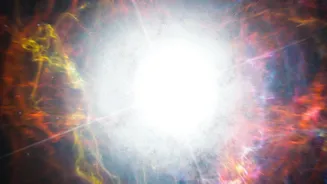


A Universe of Missing Explosions
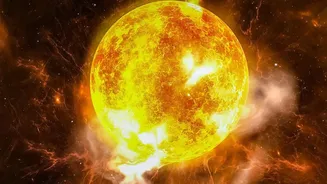
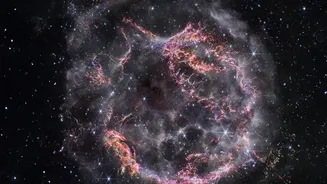
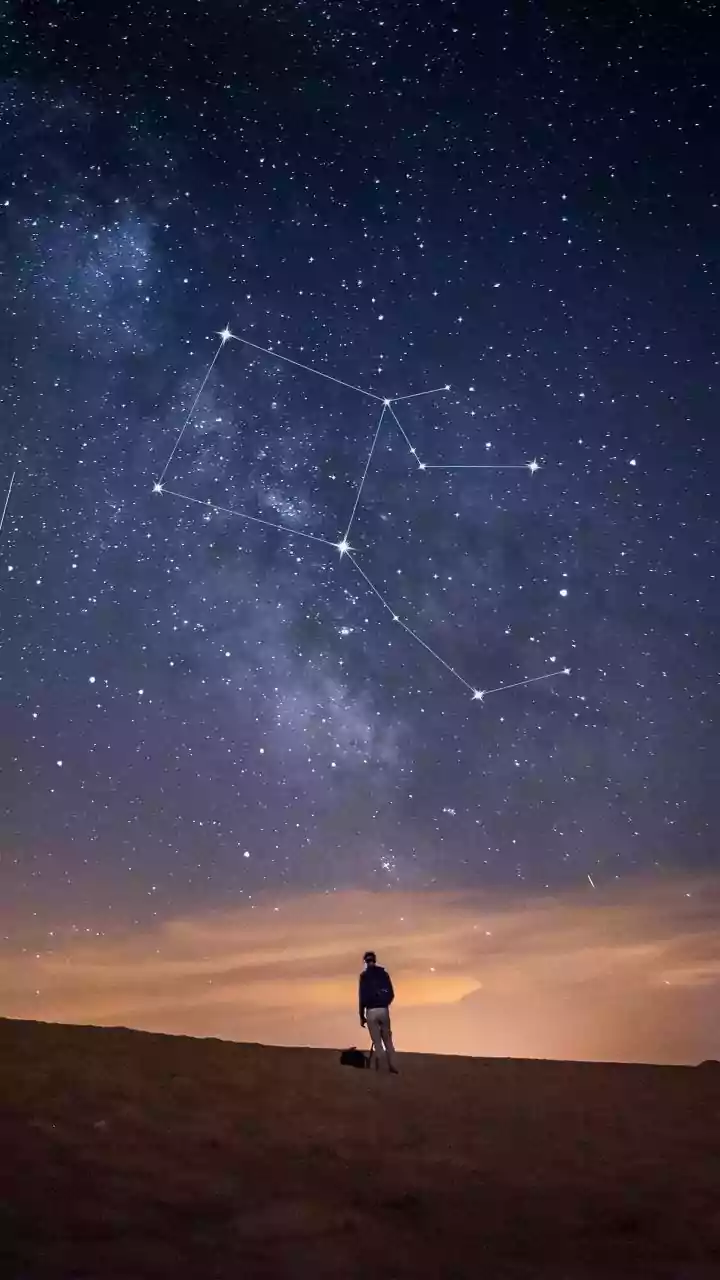
The Milky Way is a bustling metropolis of hundreds of billions of stars. Based on the rate at which massive stars are born and die, astronomers expect to witness a core-collapse supernova—the spectacular death of a star at least eight times the mass of our
sun—roughly once or twice every century. However, the last confirmed supernova seen in our galaxy was Kepler's Star in 1604. This glaring discrepancy is known as the "missing supernova problem" or the "supernova rate problem". The leading theory is not that the explosions aren't happening, but that we simply can't see them. The vast clouds of cosmic dust and gas that fill the galactic plane act like a thick interstellar fog, obscuring the visible light from these cataclysmic events and hiding them from our telescopes.
Enter the Ghost Particle
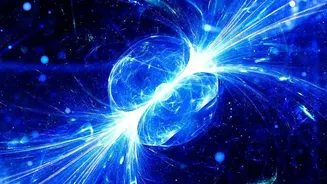
This is where neutrinos come in. Often called 'ghost particles', neutrinos are fundamental particles with almost no mass and no electric charge. They are produced in incredible numbers by nuclear reactions, like those inside stars. What makes them special is that they barely interact with other matter at all. Trillions of neutrinos from the sun pass through your body every second without you ever noticing. While this elusive nature makes them incredibly difficult to detect, it also allows them to travel unimpeded through material that would stop light dead in its tracks—including the dense core of a dying star and the dusty clouds of the galaxy.
A Supernova's Ghostly Signature
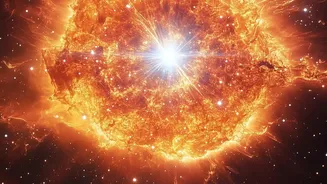
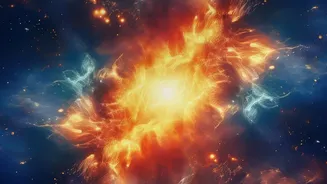
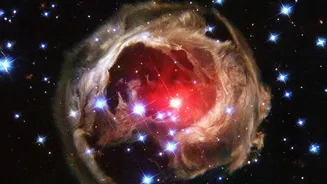
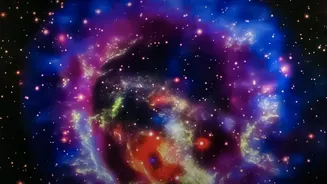
When a massive star's core collapses under its own gravity, it triggers a supernova. In this incredibly violent process, an astonishing 99% of the explosion's energy is not released as light, but as a colossal, ten-second burst of neutrinos. This neutrino flood is the true, unfiltered signature of a star's death. Because these particles escape the star's core almost instantly, they race out into the cosmos hours or even days before the first light from the explosion emerges. This makes a neutrino burst both a definitive fingerprint of a supernova and a potential early warning system for an explosion that might otherwise remain hidden.
Listening for Cosmic Whispers
Detecting these cosmic ghosts requires immense and sensitive instruments. Observatories like Japan's Super-Kamiokande and the IceCube Neutrino Observatory at the South Pole consist of enormous tanks filled with thousands of tons of purified water, lined with ultra-sensitive light detectors. These gigantic detectors wait patiently for the telltale flash of light, called Cherenkov radiation, that is produced when a rare neutrino finally interacts with a water molecule. A sudden, massive spike in these interactions across multiple detectors around the globe would be an unmistakable signal that a supernova has just occurred somewhere in our galactic neighborhood. Projects like the Supernova Early Warning System (SNEWS) link these global detectors together, ready to alert astronomers the moment a neutrino burst is confirmed.
Solving a Two-Part Mystery
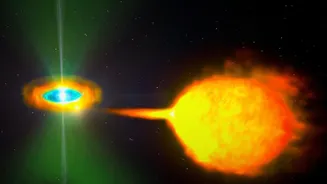
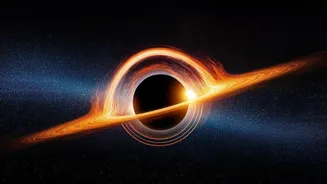
By 'seeing' these otherwise invisible neutrino bursts, scientists can finally get an accurate census of how many stars are exploding in our galaxy, potentially solving the missing supernova problem. But recent research suggests neutrinos may also explain why some stars are missing. A study published in late 2026 suggests that the way neutrinos change their 'flavor' or type inside a collapsing star can determine its fate. For certain massive stars, these flavor changes might prevent a full-blown supernova, causing the star to collapse directly into a black hole with little to no visible explosion. These 'failed supernovae' would simply vanish from sight, contributing to the count of missing explosions. Therefore, neutrinos not only provide the tool to find hidden supernovae but may also explain why some don't happen at all.