






A Telescope Designed for the Future
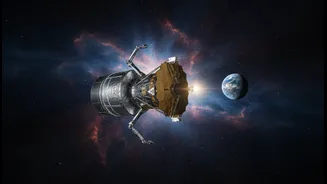
Set to launch in the 2040s, the Habitable Worlds Observatory (HWO) has an ambitious primary goal: to be the first telescope designed specifically to find and study Earth-like planets orbiting other stars, searching for signs of life. With an estimated
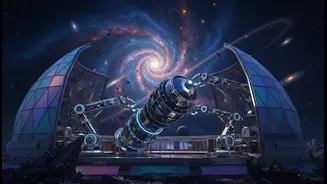
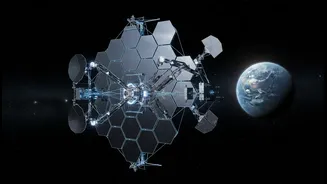
cost of $11 billion, this flagship mission aims to directly image at least 25 potentially habitable worlds and analyze their atmospheres for chemical biosignatures like oxygen and methane. But unlike past observatories, HWO is being built with a crucial difference. From its inception, the telescope is being designed for in-space servicing, assembly, and maintenance. This means that rather than being a static piece of technology, HWO is envisioned as a long-term, upgradable platform in space.
Learning from Hubble and Webb
The decision to make HWO serviceable is a direct lesson from its predecessors. The Hubble Space Telescope, launched into low-Earth orbit, was famously saved and upgraded by Space Shuttle astronaut missions. These service calls swapped out old instruments for new, more powerful ones, dramatically extending Hubble's life and scientific capabilities far beyond its original design. In contrast, the James Webb Space Telescope (JWST) was sent to a location one million miles from Earth, a vantage point that makes it incredibly powerful but also impossible to service with current technology. Its instruments are fixed for its entire lifespan. HWO will also be at this distant location, but NASA is mandating a modular design with robotic servicing in mind, representing a fundamental shift in strategy.
Robots, Not Astronauts
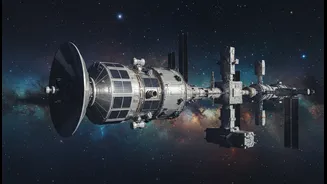
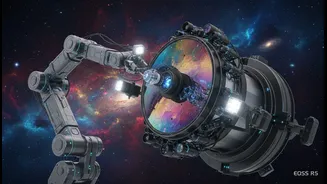
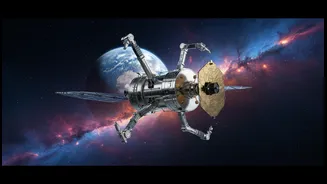
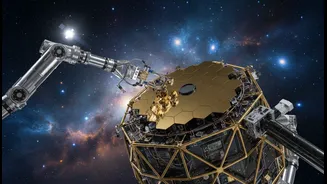
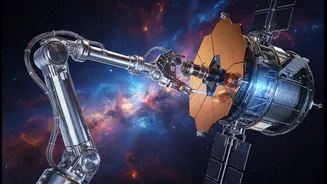
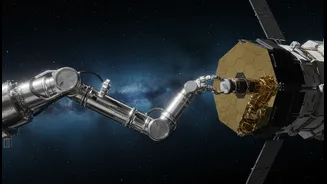
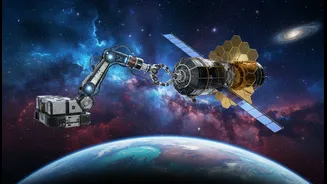
Servicing HWO won't involve astronauts in a shuttle. Instead, NASA envisions a future where autonomous or remote-controlled robotic spacecraft will perform the maintenance. These robotic mechanics would be able to latch onto the observatory, perform repairs, refuel the thrusters, and, most importantly, swap out scientific instruments. The observatory's critical components will be designed as standardized modules, known as line-replaceable units (LRUs), that can be easily slid out and replaced. This approach not only extends the mission's life indefinitely but also allows it to incorporate technological breakthroughs that haven't even been invented yet, ensuring the observatory remains at the cutting edge for decades to come.
A Catalyst for a New Industry
This commitment to robotic maintenance is expected to be a major driver for the emerging in-space servicing, assembly, and manufacturing (ISAM) industry. By designing its premier future observatory around a commercial servicing model, NASA is creating a guaranteed future market for companies developing these advanced robotic capabilities. The plan may even involve robots assembling parts of the telescope in space if the final design is too large to fit into a single rocket fairing. This forward-thinking strategy reduces risk, maximizes the scientific return on a massive investment, and ensures that HWO can adapt to the scientific questions of the 2050s and beyond, whatever they may be.