








A Flyby with a Twist
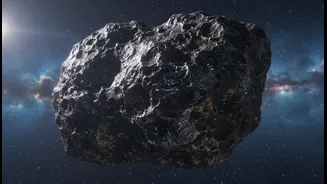
On its 12-year journey to study Jupiter's Trojan asteroids, NASA's Lucy spacecraft had a scheduled practice run. In November 2023, it flew past a small main-belt asteroid named Dinkinesh, primarily to test its tracking systems. Scientists weren't expecting
major revelations from what they thought was just another rock in space. But the cosmos often has other plans. Even before the flyby, mission scientists noted odd variations in Dinkinesh's brightness, hinting that it might not be alone. The initial images confirmed it: Dinkinesh had a tiny moon, which was later named Selam. This was exciting, but the real mystery was just beginning to unfold.
A Moon That Looked Like Two
As Lucy transmitted more detailed images, Selam's appearance became even more peculiar. The first pictures to arrive after the closest approach showed what looked like a “contact binary”—two smaller asteroids that had gently bumped into each other and become fused. This type of object, sometimes compared to the shape of a peanut or a snowman, is common in the solar system. However, seeing one orbiting another asteroid was a first for scientists. The initial view, however, was deceptive. Because of Lucy's viewing angle at the moment of closest approach, the two lobes of Selam were perfectly aligned, one behind the other, hiding the moon's true form.
Unlocking the Motion Clues
The breakthrough came from analyzing a sequence of images taken in the minutes surrounding the flyby. These images, captured as Lucy sped past at over 16,000 kilometers per hour, offered different perspectives of the Dinkinesh system. By carefully tracking the relative positions of the two lobes of Selam, the science team noticed they were moving. This was the critical “motion clue.” Selam wasn't a single, solid object. It was, in fact, two separate moons of nearly equal size, each about 220 meters in diameter, orbiting each other while they jointly circled the larger Dinkinesh. This discovery transformed our understanding of the system from a simple asteroid-moon pair into a complex and dynamic triple system.
Why This Cosmic Dance Matters
Discovering a pair of moons orbiting each other is more than just a cosmic curiosity; it's a natural laboratory for understanding planetary formation. The forces holding Selam's two components together are incredibly delicate. This system provides unprecedented insight into accretion, the process by which dust and rock in the early solar system clumped together to form larger bodies, and eventually, planets. Scientists believe Dinkinesh itself likely spun so fast at one point that it shed material from its equator. Some of this material fell back to create a ridge on Dinkinesh, while the rest coalesced to form Selam's two lobes. Studying how these tiny bodies interact helps refine models of how celestial objects are built, from tiny moons to massive planets.