






Meet Pandora, NASA's Newest Planet Hunter
Launched in January 2026, NASA's Pandora mission officially began its science operations in late August 2026, marking a new chapter in the study of exoplanets—planets outside our solar system. Pandora is a SmallSat, a compact and cost-effective satellite,
designed for a very specific and crucial task: to help scientists accurately determine the makeup of alien atmospheres. Over its year-long primary mission, it will observe at least 20 known exoplanets, studying them with a level of focus that larger telescopes often cannot afford. This mission isn't designed to discover thousands of new planets like its predecessor, Kepler. Instead, its job is to add a layer of critical detail to the planets we're already watching, especially those observed by the powerful James Webb Space Telescope (JWST).
The Problem with Starlight
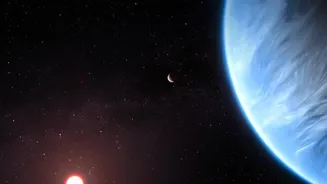
When scientists study a distant exoplanet's atmosphere, they typically use a technique called transit spectroscopy. As a planet passes in front of its star, a tiny fraction of the star's light filters through the planet’s atmosphere. The chemicals in that atmosphere absorb certain colours, or wavelengths, of light, leaving a unique chemical fingerprint that telescopes like JWST can read. The problem is that stars aren't perfectly stable, uniform balls of light. They have their own atmospheric features, like sunspots and flares, which can create signals that mimic or mask the signature of a planet's atmosphere. A scientist might think they’ve detected water on a distant world, but the signal could actually be coming from a cool spot on the star itself. “Right now, we can't be entirely sure how the star's light affects measurements of what makes up exoplanet atmospheres,” said Elisa Quintana, Pandora’s principal investigator. This stellar contamination is a major headache for astronomers, potentially leading to misinterpretations of the data.
How Pandora Solves The Puzzle
Pandora's clever solution is to stare at a planet and its star simultaneously, using two different kinds of light. It captures data in both visible and near-infrared wavelengths at the same time. This dual-pronged approach allows scientists to model the activity of the host star with great precision. By understanding what the star is doing, they can effectively subtract its 'noise' from the combined signal, isolating the true atmospheric data of the planet. To do this, Pandora will dedicate significant time to each of its targets, observing each of the 20 planets ten times, for 24 hours at a stretch. This long-duration stare is something larger observatories like JWST, which are in high demand, can't typically do. Pandora will provide the context needed to make JWST's data more reliable.
The Search for Biosignatures
The ultimate goal of this atmospheric detective work is the search for biosignatures—gases or combinations of gases that could indicate the presence of life. On Earth, for example, the high concentration of oxygen is a direct result of life. Finding a similar mix of gases, such as oxygen and methane together, on a rocky exoplanet in its star’s habitable zone would be a monumental discovery. But these signals are incredibly faint and easy to misread. By providing cleaner, more reliable atmospheric data, Pandora helps lay the groundwork for future, more ambitious missions like the proposed Habitable Worlds Observatory (HWO). HWO is a next-generation space telescope, planned for the 2040s, that will be specifically designed to directly image Earth-like planets and hunt for signs of life. Pandora's work ensures that when these powerful future telescopes look for life, they are starting with the most accurate information possible.