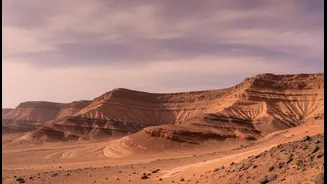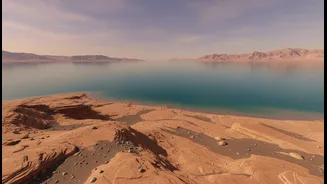






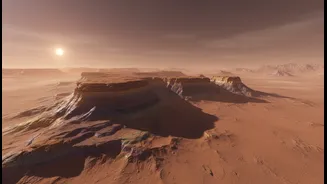
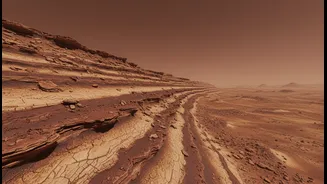


An Ocean World Next Door?
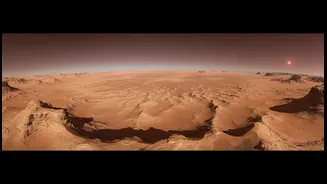
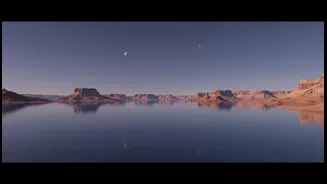
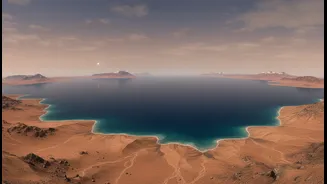
The idea of a wet, and perhaps warmer, ancient Mars has captivated scientists for years. While rovers have found ample evidence of past rivers and lakes, the theory of a massive ocean covering the planet's northern third remained controversial. The northern hemisphere
of Mars is significantly lower in elevation and smoother than the crater-pummeled south, hinting that a body of water once filled this basin, known as Vastitas Borealis. Early evidence was often based on identifying potential shorelines in satellite imagery, but these features appeared at inconsistent elevations, weakening the case. Recent studies, however, have taken a different approach. By analyzing topographic data, researchers identified a vast, flat feature analogous to the continental shelves found on Earth, where land slopes gently into the deep ocean. This shelf, which would have taken millions of years of stable water to form, provides some of the strongest support yet for a long-lasting Martian ocean about 3.5 billion years ago.
The Scientific Prize: A Frozen Time Capsule
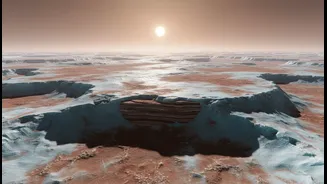
The discovery of this coastal shelf does more than just settle a long-standing geological debate; it provides a treasure map for future missions. If Mars ever hosted life, the sedimentary deposits left behind by this ancient ocean are a prime place to look for its fossilized remains, or biosignatures. Just as on Earth, coastal areas are rich environments where signs of life could be concentrated and preserved. More excitingly, much of the water from this ancient ocean is believed to still be there, locked away as enormous deposits of subsurface ice. The polar regions and surrounding plains are thought to hold vast quantities of water ice just beneath a layer of dust and rock. These ice layers, like ice cores drilled in Antarctica, could contain a pristine, frozen record of Mars' climatic history. Even more compelling, lab studies suggest that amino acids, the building blocks of life, could survive for tens of millions of years if trapped in clean ice, protected from the harsh surface radiation.
A New Target in the Search for Life
This makes the northern shelf a high-priority target, potentially rivaling sites like Jezero Crater, where the Perseverance rover is currently searching for signs of past microbial life. The key difference is the preservation method. While Perseverance is drilling into rock, future missions to the north would aim to drill into ice. The scientific community is increasingly advocating for this shift in strategy. Accessing this ice could answer fundamental questions about how Mars lost its atmosphere and transformed from a potentially habitable world into a cold desert. The presence of this ice also makes the region a critical resource for future human explorers, who could potentially mine it for drinking water, breathable air, and even rocket fuel.
The Challenges of the Martian North
Exploring the Martian north will not be easy. The polar regions are incredibly cold and subject to long periods of darkness during the winter, posing significant challenges for solar-powered landers and rovers. The 2008 Phoenix lander, which successfully scooped up subsurface ice in the region, only survived for about five months before succumbing to the harsh winter. Furthermore, accessing the most promising scientific targets requires drilling, potentially meters deep, through a protective layer of rock and dust. Technologies for deep drilling on Mars are still in development, with companies like Honeybee Robotics testing systems designed to melt through ice and extract water. Another innovative concept involves using radar-equipped drones to fly low over the surface, mapping the exact depth and purity of buried ice to identify the most promising drilling locations.
What's Next for Mars Exploration?
The path forward for Mars exploration is currently in flux. NASA is re-evaluating its ambitious Mars Sample Return program, potentially opening the door for new, lower-cost missions. China is proceeding with its own sample return mission, Tianwen-3, planned for 2028. While these missions are not targeting the northern ice deposits, the growing consensus around the importance of the northern shelf could influence the next generation of mission planning. An orbiter mission concept, the Mars Ice Mapper, has been proposed to specifically hunt for near-surface ice across the planet, which would be crucial for planning any future landing. As technology advances and the scientific case grows stronger, a robotic mission designed to drill into the northern plains seems less a matter of if, but when. These ancient coastal plains may hold the key to finally answering whether we have ever been alone in the universe.