



A New, Unprecedented View
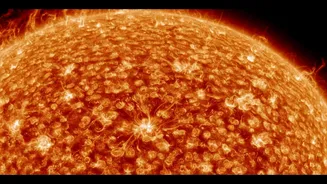
Scientists are looking at our sun in more detail than ever before, thanks to new, ultra-high-resolution images. These are not just pretty pictures; they are scientific data of the highest quality. Recent images, particularly from instruments like the Daniel
K. Inouye Solar Telescope in Hawaii, are revealing the sun's surface, or photosphere, with astonishing clarity. These images capture features as small as a city, showing a landscape of boiling, cell-like structures of plasma, each about the size of Texas. Within these images, scientists have for the first time directly observed a phenomenon long predicted by theory: the Kelvin-Helmholtz instability. This appears as swirling, wave-like patterns created when streams of solar plasma flow past each other at different speeds, much like wind creating waves on water. Seeing these fine details is crucial because it helps scientists test and refine their theories about the sun's fundamental physics.
The Mystery of Solar Energy
One of the longest-standing puzzles in solar physics is the coronal heating problem. The sun's visible surface is about 6,000 degrees Celsius, but its outer atmosphere, the corona, is hundreds of times hotter, reaching millions of degrees. This defies simple logic; you would expect the temperature to decrease as you move away from a heat source. The energy that powers our solar system originates from nuclear fusion deep within the sun's core. This energy travels outwards, but how it is transported and deposited into the corona to make it so incredibly hot has been a major question. For decades, scientists have theorized that the answer lies in the sun's complex magnetic fields and the turbulent motion of its plasma—a superheated, electrically charged gas that makes up the sun.
Decoding the Fiery Details
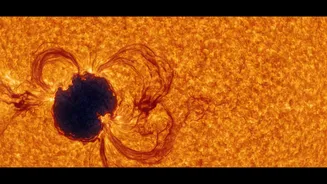
The new high-resolution images provide visual evidence that helps solve this puzzle. The observed Kelvin-Helmholtz instabilities, those tiny whirlpools on the sun's surface, are significant because they show where energy might be getting transferred. These instabilities can cause a mixing of plasma and magnetic fields, which could be a key mechanism for moving energy from the sun's surface up into its atmosphere. Another popular theory for coronal heating involves nanoflares—tiny, constant explosions happening all over the sun, far too small and numerous to see individually until now. Instruments like NASA's High-Resolution Coronal Imager (Hi-C), a sub-orbital telescope, have captured images revealing incredibly fine, thread-like structures of plasma, sometimes called magnetic braids. Scientists believe that the tangling and reconnecting of these magnetic field lines could trigger these nanoflares, releasing bursts of energy that, when combined, could account for the corona's extreme temperature.
Why Studying the Sun Matters
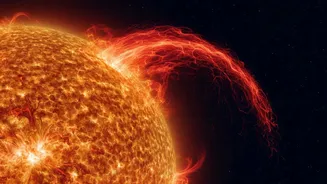
Understanding how energy moves through the sun is more than just an academic exercise. The same magnetic forces that heat the corona are also responsible for massive solar events like solar flares and coronal mass ejections (CMEs). When these eruptions are directed at Earth, they can have serious consequences. They create space weather that can disrupt our communications satellites, knock out power grids, and interfere with GPS navigation. By grasping the underlying physics of what drives these events, scientists hope to improve their ability to predict space weather. Better forecasting can give us time to protect our critical infrastructure and astronauts in space. These new, incredibly detailed observations are a massive leap forward, turning theoretical models into observable phenomena and paving the way for a new era of solar science.