







What is the Big BRICS Push?
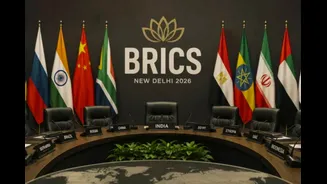
The BRICS group—which includes Brazil, Russia, India, China, South Africa, and a growing list of new members like Egypt, Iran, and Saudi Arabia—is moving beyond political coordination to build a tangible economic framework. This concerted push has two
main goals: first, to dramatically increase trade and investment among member nations, and second, to reduce their collective dependency on the U.S. dollar for international transactions. While intra-BRICS trade has grown significantly, it still only represents a small fraction of global trade, leaving substantial room for growth. Under India's 2026 chairmanship, the focus has been on practical cooperation, advancing a strategy for economic partnership that covers trade, investment, digital economy, and sustainable development.
The Drive for De-Dollarization
At the heart of the BRICS economic strategy is the move toward "de-dollarization." For decades, the U.S. dollar has been the world's primary currency for trade and reserves. However, this exposes economies to U.S. monetary policy and geopolitical risks like sanctions. By promoting the use of local currencies—such as the Indian Rupee, Chinese Yuan, and Russian Ruble—for trade settlements, BRICS members aim to gain more economic sovereignty. This means when Indian businesses trade with Brazilian or South African counterparts, they could increasingly do so directly in their own currencies, bypassing the need to convert to and from the dollar. This reduces transaction costs, exchange rate risks, and vulnerability to external financial pressures.
The Key Development: A New Payment System
The most significant recent development is the concerted effort to create an independent payment system, sometimes referred to as "BRICS Pay." This initiative aims to connect the domestic payment systems of member countries—like India’s Unified Payments Interface (UPI), Brazil’s Pix, and China’s CIPS—to create a new, seamless corridor for cross-border transactions. The Reserve Bank of India (RBI) has reportedly proposed a framework for linking the Central Bank Digital Currencies (CBDCs) of BRICS nations, a plan expected to be a major topic at the 2026 summit in New Delhi. If implemented, this blockchain-based system would operate independently of the SWIFT network, making trade and payments faster, cheaper, and more accessible for all members.
How Will This Impact India?
For India, these developments present both opportunities and strategic advantages. As a key driver of the initiatives under its 2026 presidency, India is positioning itself as a leader in this new financial architecture. The internationalization of India's UPI will play a central role, potentially becoming a standard for digital financial services across the Global South. Increased trade in local currencies could lower costs for Indian exporters and importers, making them more competitive. Furthermore, it enhances India's strategic autonomy, allowing it to maintain crucial trade relationships for imports like energy and defence, even amid geopolitical tensions. By helping to shape global regulations on digital trade and finance, India is securing its role as a major player in the evolving world order.
Challenges on the Road Ahead
Despite the ambitious vision, the path forward is not without significant hurdles. The U.S. dollar remains deeply entrenched in the global financial system, accounting for the vast majority of international transactions. Creating a viable alternative requires immense technical, legal, and political coordination among BRICS members, who have diverse economic systems and interests. Building institutional trust and ensuring the transparency and stability of a new payment system is a monumental task. Furthermore, there are geopolitical balancing acts to consider, as an aggressive move away from the dollar could create friction with Western nations. India, in particular, is navigating this shift cautiously, focusing on building practical cooperation and consensus within the bloc.