


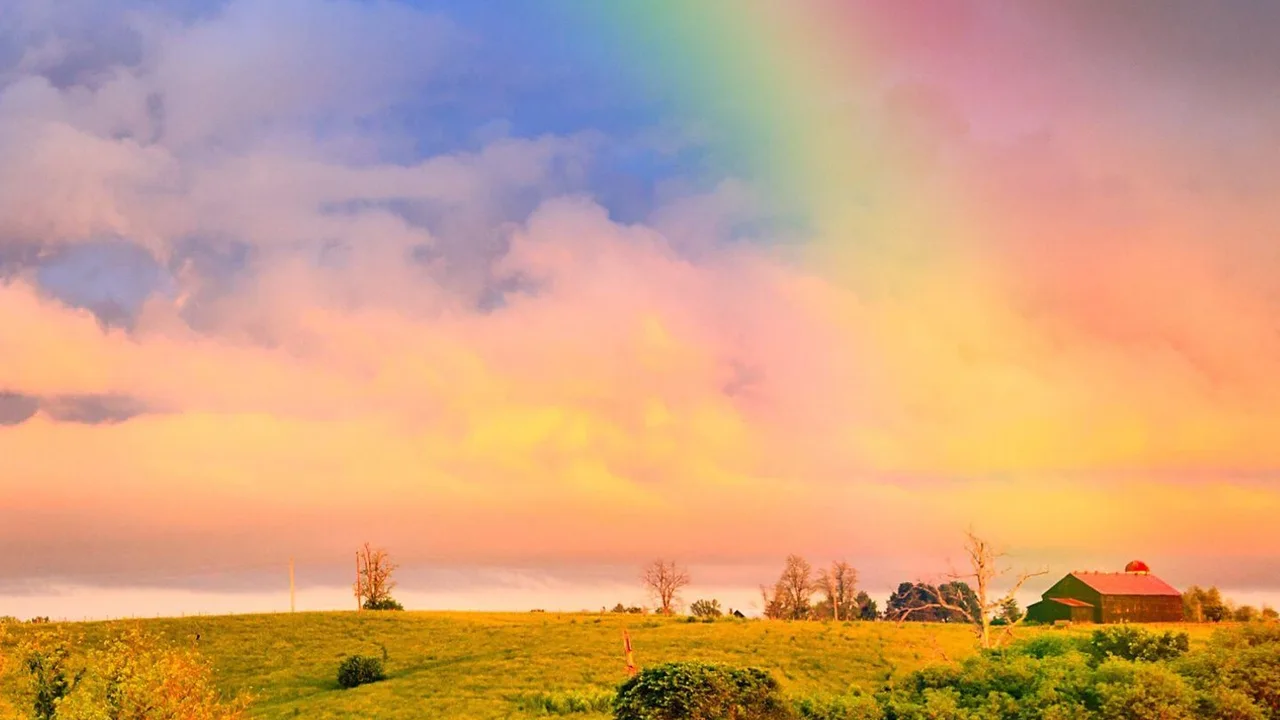

It’s Not Fire, It’s a ‘Fire Rainbow’
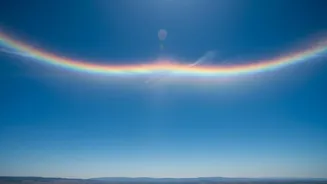
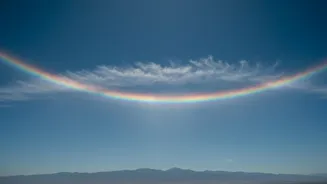
First things first: despite the dramatic and popular name, this phenomenon has nothing to do with fire. It's also not technically a rainbow. The correct scientific term is a circumhorizontal arc. This captivating display is an optical effect that belongs
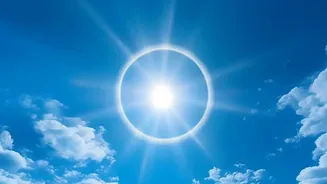
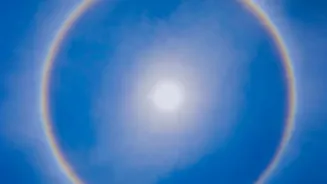
to a family of phenomena called ice halos. Unlike a true rainbow, which is formed by the refraction and reflection of light in water droplets, a circumhorizontal arc is created when light passes through ice crystals high up in the atmosphere. The term 'fire rainbow' was likely coined because its vibrant, flame-like appearance can seem to set the clouds ablaze, especially when seen in patchy cirrus clouds.
The Two-Part Recipe: Ice and Angle
For this beautiful arc to appear, a very specific set of atmospheric conditions must be met. The two crucial ingredients are high-altitude cirrus clouds and a very high sun. These aren't just any clouds; they must be filled with tiny, plate-shaped, hexagonal ice crystals. Furthermore, these crystals need to be oriented horizontally, floating flat like tiny dinner plates suspended in the sky. The second, and most critical, condition is the angle of the sun. The sun must be at an elevation of at least 58 degrees above the horizon. This is why you're more likely to see a circumhorizontal arc during the summer months and around midday, when the sun is at its highest point in the sky.
A Prism in the Sky
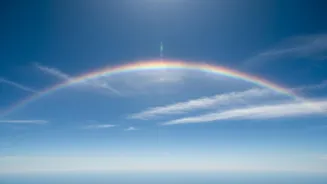
When the sun is high enough, its light enters the vertical side of one of these flat, hexagonal ice crystals and exits through the horizontal bottom face. This 90-degree bend acts like a prism, splitting the sunlight into its component colors and projecting a brilliant spectrum. The result is a large, colorful band running parallel to the horizon, often so wide that it can be hard to see the entire arc at once. The colors are purer and more ordered than in a rainbow, with red always appearing on top. This specific alignment and refraction are what distinguish it from other atmospheric displays and create its signature broad, rainbow-like smear across the sky.
Location, Location, Location
The strict requirement for a high sun angle means that these 'fire rainbows' are impossible to see from everywhere on Earth. For observers in locations north of 55° latitude (think northern Europe) or south of 55° latitude, the sun never gets high enough in the sky—even in the middle of summer—for a circumhorizontal arc to form. In the mid-latitudes, however, like much of the United States, they are a relatively common sight during the summer if you know when and where to look. The key is to watch for thin, wispy cirrus clouds on a bright, sunny day when the sun is near its peak.
How to Tell It Apart from Other Sky Wonders
The sky is full of optical illusions that can be easily confused. A circumhorizontal arc is often mistaken for cloud iridescence, but iridescence has more random, pastel-like color patches and can appear anywhere around the sun. Another relative is the circumzenithal arc, which also shows brilliant rainbow colors but forms an upside-down arc high above the sun when the sun is lower in the sky (below 32 degrees). Sundogs, or parhelia, are bright spots of light that appear on either side of the sun, often as part of a 22-degree halo, and are most noticeable when the sun is low. A 'fire rainbow,' by contrast, is always below the sun and parallel to the horizon.