
What is the Ring of Fire?
The Ring of Fire is a massive, horseshoe-shaped area that encircles the Pacific Ocean. Stretching approximately 40,000 kilometres, it is the planet's most geologically active region. This zone is home to about 75% of the world's active volcanoes and is responsible
for roughly 90% of its earthquakes. It's not a single, continuous structure but a collection of plate boundaries where several tectonic plates—giant slabs of Earth's crust—collide, separate, and slide past one another. This intense interaction makes the coasts of countries like Japan, the Philippines, Chile, and the western United States hotbeds of seismic and volcanic events.
The Engine Room: Plate Tectonics
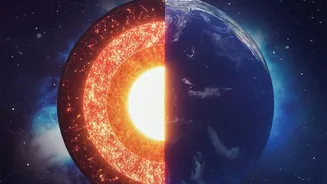
To understand why the Pacific is shrinking, we need to look at the process of plate tectonics. The Earth's surface is broken into several large plates that float on the semi-molten mantle beneath. These plates are in constant, slow motion. At mid-ocean ridges, like the East Pacific Rise, new oceanic crust is formed as magma rises, cools, and pushes older crust outwards. This is called seafloor spreading. However, to balance the creation of new crust, old crust must be destroyed elsewhere. This happens at what are called subduction zones, which are the dominant feature of the Ring of Fire.
The Great Disappearing Act: Subduction
Subduction is the geological process at the heart of our story. It occurs when two tectonic plates collide, and one, typically the denser oceanic plate, is forced to slide beneath the other into the Earth's mantle, where it is recycled. The Pacific Ocean is surrounded by these subduction zones, acting like a planetary bathtub drain. The massive Pacific Plate, along with smaller plates like the Nazca and Juan de Fuca, is being pushed under the surrounding continental plates of Asia, Australia, and the Americas. This process creates deep oceanic trenches, such as the Mariana Trench, the deepest part of the ocean, and fuels the volcanoes that give the Ring of Fire its name.
A Slow but Inexorable Process
While the headline's image of the basin being 'eaten away' is dramatic, the process is incredibly slow from a human perspective. The Pacific Ocean is shrinking by a few centimetres each year—roughly the speed at which your fingernails grow. The Pacific Plate is being consumed at rates varying from about 2 to 9 centimetres per year, depending on the specific subduction zone. While this may seem insignificant, over geological time, it adds up. For comparison, the Atlantic Ocean, which has very few subduction zones, is currently expanding. The net effect is that the Pacific is losing more crust at its edges than it is creating at its centre.
The Future: A New Supercontinent
What does this mean for the long-term future of our planet? Geologists, using supercomputer simulations, have forecast that this slow shrinking will continue. Over the next 200 to 300 million years, the Pacific Ocean is predicted to close completely. This will cause the continents of North America and Asia to collide, eventually forming a new supercontinent that scientists have dubbed 'Amasia'. This is part of a grand supercontinent cycle, where Earth's landmasses periodically merge into one giant continent and then break apart again over hundreds of millions of years. The shrinking of the Pacific is simply the next phase in our planet's epic, never-ending transformation.