







The Universe's Simple Start
When the universe began with the Big Bang nearly 14 billion years ago, its chemical makeup was incredibly simple. It consisted almost entirely of the lightest elements: hydrogen, helium, and a tiny amount of lithium. Every other element on the periodic
table, including the oxygen we breathe, the carbon in our bodies, and the iron in our blood, had to be created. The first factories for this cosmic manufacturing were stars. Through nuclear fusion in their incredibly hot and dense cores, stars spend their lives fusing lighter elements into heavier ones, a process called stellar nucleosynthesis.
Stellar Forges and Their Limits
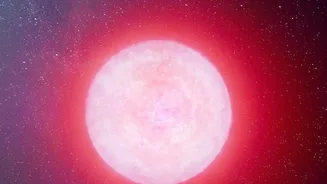
For millions or billions of years, stars act as cosmic pressure cookers. They fuse hydrogen into helium, helium into carbon, and so on, creating progressively heavier elements. This process works well for the first part of the periodic table. However, this stellar assembly line hits a wall at iron. Fusing elements up to iron releases energy, which powers the star and keeps it from collapsing under its own gravity. But fusing iron into heavier elements requires more energy than it produces. For a star, this is an energetically unprofitable and unsustainable reaction. So, while stars are responsible for creating most of the lighter elements, they cannot, on their own, forge things like gold, platinum, or uranium. For that, the universe needs something much more violent.
Cosmic Violence: Supernovae
For a long time, scientists believed the answer lay solely with supernovae, the cataclysmic explosions of massive stars at the end of their lives. When a massive star runs out of fuel, its core collapses, and it explodes, flinging its material out into space. This violent event creates conditions intense enough to forge some elements heavier than iron. Supernovae are indeed crucial for enriching the cosmos with heavy elements. However, calculations and observations eventually showed that supernovae alone couldn't account for the sheer abundance of the heaviest elements, like gold, that we find in the universe. Another, even more extreme, event was needed.
The Ultimate Cosmic Crash: Neutron Star Mergers
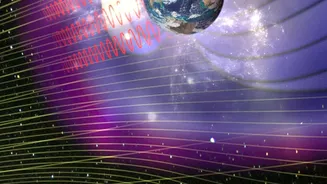
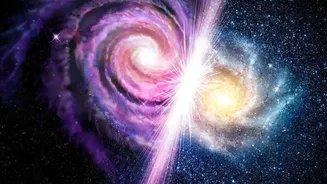
The primary source for most of the universe's heaviest elements is now understood to be the collision of two neutron stars. Neutron stars are the incredibly dense collapsed cores left behind after a supernova. When two of these city-sized, super-dense objects orbit each other, they gradually spiral inward, eventually smashing together in an event called a kilonova. This collision is one of the most energetic events in the universe, sending ripples through spacetime itself, which we detect as gravitational waves. The merger creates an environment with an extremely high density of free neutrons. This triggers a rapid neutron-capture process, or 'r-process,' where atomic nuclei are bombarded with neutrons so quickly that they transform into highly unstable, heavy nuclei, which then decay into stable heavy elements like gold, platinum, and uranium.
From Cosmic Dust to You
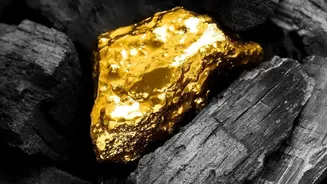
A single neutron star merger can produce quantities of gold equivalent to several times the mass of the Earth. The first direct evidence for this came in 2017, when astronomers detected both gravitational waves and electromagnetic light from a kilonova, confirming that these mergers are indeed cosmic goldmines. Over billions of years, these violent events and supernova explosions have seeded the interstellar medium—the thin gas and dust between stars—with heavy elements. This enriched material then clumps together to form new generations of stars and planets. The heavy elements on Earth, and even within our bodies, are the direct result of these ancient, cataclysmic cosmic events. The iron in your blood and the gold on your finger are quite literally stardust, forged in the most extreme moments the universe has to offer.