





Meet Pandora, a Specialist Planet Hunter
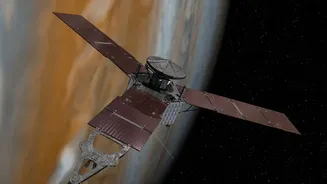
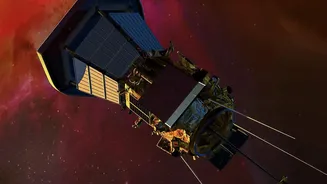
Pandora is a NASA SmallSat, part of a program designed to create lower-cost, focused missions that tackle specific scientific questions. Launched in January 2026, it joined the hunt for worlds beyond our solar system. Its primary mission is slated to last
one year, during which it will study at least 20 known exoplanets to determine what their atmospheres are made of. Unlike sprawling survey missions that find thousands of planets, Pandora is a specialist. It’s designed to provide incredibly detailed data on a handful of targets, helping to refine observations from more powerful observatories like the James Webb Space Telescope (JWST). The mission is a collaboration between several institutions, including NASA's Goddard Space Flight Center and Lawrence Livermore National Laboratory.
The Science of a Planet's Shadow
To study a planet hundreds of light-years away, astronomers often rely on the 'transit' method. When an exoplanet passes directly in front of its host star from our perspective, it blocks a tiny fraction of the starlight, causing a measurable dip in brightness. But the real magic happens at the planet’s edge. A sliver of starlight filters through the planet's atmosphere, and the gases within that atmosphere absorb light at specific wavelengths. This process leaves behind a chemical fingerprint—a code that scientists can read to identify molecules like water, methane, or carbon dioxide. This technique, called transmission spectroscopy, is one of our most powerful tools for peering into the skies of other worlds.
The Problem of a 'Flickering' Star
The transit method has a significant challenge: stars are not perfect, steady lightbulbs. Their surfaces are dynamic, featuring dark starspots (like sunspots) and bright patches called faculae. As the star rotates, these features can change, causing the star's own light to fluctuate. This stellar variability creates noise in the data that can mimic or, worse, completely hide the faint atmospheric signal from the planet. Scientists call this 'stellar contamination,' and it can lead to frustrating ambiguity. For example, it can be difficult to tell if a water vapor signal is genuinely from the planet’s atmosphere or from cool starspots on the star itself. This issue is especially pronounced with the M-dwarf stars Pandora will study, which are known for being magnetically active.
Pandora’s Solution: The Long Stare
This is where Pandora’s unique strategy comes in. The mission will conduct long-duration observations of its targets, staring at a star system for about 24 hours at a time, capturing the planet’s transit within that window. By watching the star for many hours before and after the planet passes, Pandora can get a clear measurement of the star’s own flickering and variability. It captures this data simultaneously in both visible and near-infrared light, allowing scientists to build a precise model of the star's activity. With this model, they can effectively subtract the star's noise from the transit data, isolating the pure, clean signal from the exoplanet's atmosphere. This ability to 'disentangle' the two signals is Pandora's main goal.
Laying the Groundwork for Future Discoveries
Pandora isn't designed to find habitable planets on its own. Instead, it serves a critical supporting role for larger, more powerful telescopes. The clean data it provides will help scientists better interpret the information gathered by JWST, ensuring that conclusions about atmospheric composition are built on a solid foundation. Flagship missions like JWST have packed schedules and cannot afford to spend 24 hours staring at a single target just to characterize the star. Pandora can do that dedicated, time-intensive work, identifying which planets are truly the most promising candidates for follow-up studies and helping astronomers understand the properties of their host stars with unprecedented clarity. In doing so, it plugs a critical knowledge gap in our search for life beyond Earth.