



Meet the Celestial Heavyweight
Imagine a planet that is only about two and a half times wider than our own, yet weighs as much as 23 Earths combined. That is the puzzle presented by GJ 523b, a newly discovered exoplanet located about 87 light-years away. This incredible density places
it in a rare and informal class of objects called 'mega-Earths'. For perspective, it’s as if you found a basketball that somehow weighed as much as a small car. This discovery was made by a team of astronomers led by the University of Wisconsin-Madison, who first spotted the potential planet using NASA's Transiting Exoplanet Survey Satellite (TESS) and confirmed its incredible mass with ground-based telescopes. They found a world that completes an orbit around its star every 17.75 days and is, astronomically speaking, quite young at only about 170 million years old.
Breaking the Rules of Planet Formation
The existence of GJ 523b flies in the face of conventional planetary science. According to established theories, once a growing planet's solid core reaches about 10 to 20 times the mass of Earth, its gravity becomes powerful enough to rapidly pull in enormous amounts of hydrogen and helium gas from its parent star's protoplanetary disk. This process should create a gas giant, similar to Jupiter or Neptune. Yet, GJ 523b, despite crossing this critical mass threshold at around 23 Earth masses, has somehow remained a dense, rocky world with very little atmosphere. "This isn't what we expected at all," said Max Kroft, the study's lead author. While dense planets are not unheard of—Mercury in our own solar system is quite dense—they are typically much smaller. GJ 523b is in a class of its own, forcing a rewrite of the planetary rulebook.
How Could Such a Planet Exist?
So, how did this cosmic anomaly come to be? Scientists are exploring several possibilities. One theory is that the planet's thick atmosphere was stripped away over time. This could happen if a planet orbits extremely close to its star, where intense radiation essentially boils the atmosphere away. However, while GJ 523b's orbit is relatively close, it isn't considered extreme enough for this to be the obvious answer, especially given the system's young age. Another, more dramatic, theory suggests a history of violent collisions. It’s possible that GJ 523b is the remnant core of a much larger planet that had its outer layers blasted off in a cataclysmic impact with another large celestial body billions of years ago. A third possibility is that it formed in a part of its solar system that was unusually rich in heavy elements, allowing it to build up a massive iron and rock core without accumulating much gas. Adding to the mystery, the planet is in a strange, nearly polar orbit, traveling over its star's poles rather than its equator, a feature that often hints at past gravitational disruptions in a system.
The Search for Answers
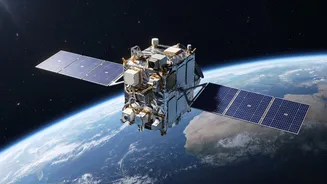
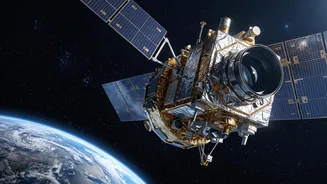
Discovering a planet is a two-step process. First, the TESS satellite detected a faint, periodic dip in the light from the star GJ 523, indicating something was passing in front of it. This 'transit method' gives astronomers the planet's size, or radius. To get its mass, the team used the WIYN 3.5-meter Telescope in Arizona. They employed a technique called the 'wobble method,' or radial velocity, which measures the tiny gravitational tug the planet exerts on its star. A bigger wobble means a more massive planet. By combining the size from the transit with the mass from the wobble, astronomers could calculate its density—and that’s when they realised they had something special. This single discovery is a starting point, and researchers hope to find more 'mega-Earths' to see if GJ 523b is a complete one-off or part of a whole new class of planet.