





A Picture Worth a Thousand Questions
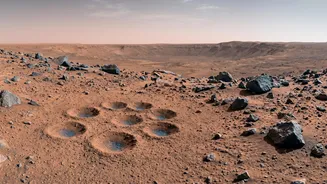
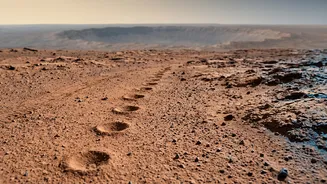
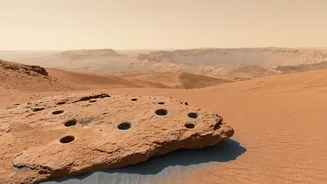
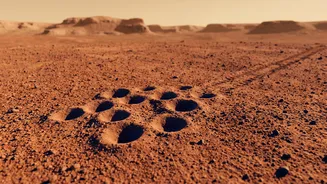
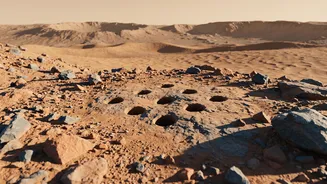
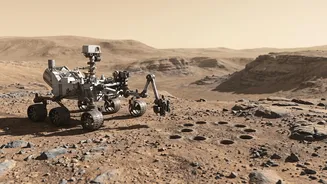
While climbing through a broad valley on the slopes of Mount Sharp, a towering mountain inside the vast Gale Crater, the Curiosity rover spotted something unusual dotting the rocky ground. The discovery consisted of several small, shallow depressions
in the bedrock. While holes are not uncommon on a planet that is constantly pelted by meteorites, these particular pits were different from anything the rover had encountered before in its many years of exploration. One of the holes, photographed in detail, measures only about a centimetre across, yet it represents a significant new geological question for the mission's science team. The images, taken by the rover's suite of advanced cameras, immediately signalled that this was not a typical Martian feature.
Not Just Another Martian Pothole
So, what makes these holes so peculiar? On both Earth and Mars, small pits in rock can often be explained by a straightforward process. A harder piece of material, like a pebble or a mineral nodule, gets embedded in softer surrounding rock. Over vast stretches of time, the softer rock erodes away, and the harder pebble eventually falls out, leaving a small cavity behind. The mystery of these new holes is that this simple explanation doesn't seem to fit. Scientists noted that the pits are unusually broad and shallow compared to previously observed features. Crucially, there are no obvious pebbles or nodules in or around the holes that look as though they once occupied the space. Without the 'key' that should have made the 'lock,' scientists are left without an easy answer.
The Hunt for an Explanation
When faced with an unknown, scientists begin a process of elimination and investigation. Several possibilities are being considered, though none have been confirmed. The holes could be the result of a unique type of erosion process not yet seen on Mars, or perhaps they point to an unusual property within that specific layer of rock. The team is now using the rover's instruments to gather more data. The Mars Hand Lens Imager (MAHLI) has taken close-up shots, while the Mastcam cameras captured stereo images of the area. These overlapping images can be used to build detailed three-dimensional models of the pits, allowing researchers to measure their precise shapes and depths. By studying their structure, the team hopes to work backward and deduce the forces that created them. It is a slow and meticulous process of digital detective work from another world.
Curiosity's Grand Mission
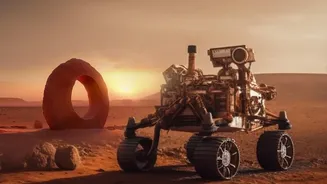
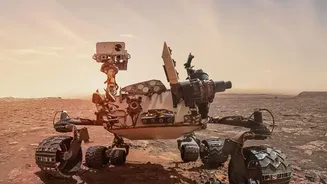
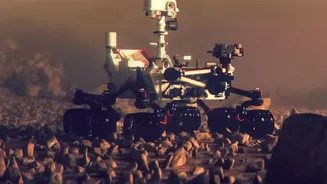
This discovery, while small, is part of the Curiosity rover's larger mission: to read the history of Mars written in its rocks. The rover has been ascending Mount Sharp since 2014 precisely because its layered sediments act like pages in a history book. By analysing different layers as it climbs, Curiosity provides invaluable information about how the Martian environment has changed over billions of years, particularly how it transformed from a potentially wet and habitable world into the cold, dry planet we see today. The rover is more than just a camera; it is a fully operational analytical laboratory on wheels, equipped with a drill to collect rock samples and sophisticated instruments to analyse their chemical makeup. Each strange rock formation or unexplained feature like these holes adds a new piece to the grand puzzle of Mars's past.