




A Renewed Interagency Partnership
NASA and the U.S. Department of Energy (DOE) recently signed a new Memorandum of Understanding to accelerate the development of nuclear technologies for space. This agreement, titled 'Accelerating American Leadership in Space Nuclear Power and Propulsion,'
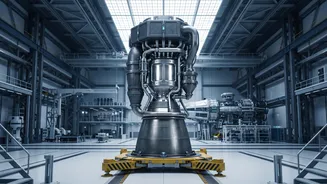
solidifies a collaboration that spans research, fuel production, and testing. The partnership formalizes the joint effort to create both nuclear propulsion systems to get to deep-space destinations faster and nuclear fission systems to provide power once we arrive. This move is seen as a critical enabler for NASA's long-term ambitions, including establishing a sustained human presence on the Moon under the Artemis program and eventually sending astronauts to Mars.
The Need for Speed: Nuclear Propulsion
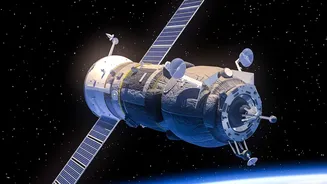
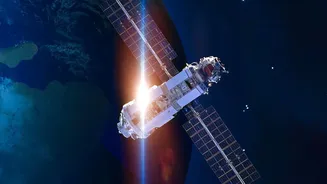
One of the major hurdles for a human mission to Mars is the travel time. A round trip using conventional chemical rockets could take up to three years, exposing the crew to prolonged periods of dangerous cosmic radiation. This is where nuclear propulsion comes in. NASA is focused on two main types: Nuclear Thermal Propulsion (NTP) and Nuclear Electric Propulsion (NEP). NTP systems work by using a fission reactor to heat a liquid propellant like hydrogen, which then expands into a gas and is expelled to create powerful thrust. This method is about twice as efficient as chemical rockets and could shorten the journey to Mars by a quarter or more. NEP, on the other hand, uses the reactor to generate electricity, which then ionizes a propellant like xenon to create a low but highly efficient and continuous thrust. NASA's Space Reactor-1 (SR-1) Freedom mission, targeting a 2028 launch, aims to be the first demonstration of a fission-powered interplanetary spacecraft.
Powering a Home on the Moon
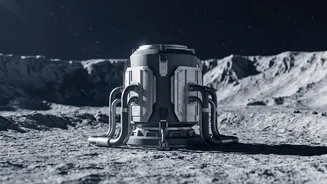
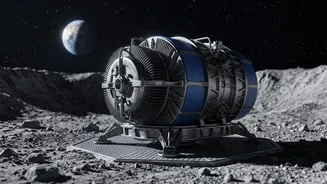
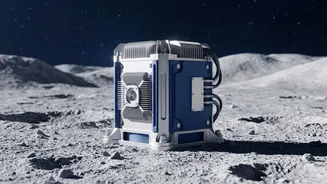
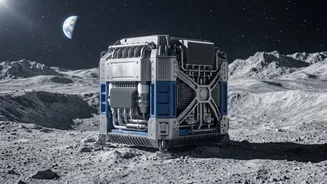
Beyond getting there, astronauts will need a reliable power source to live and work in space, especially on the lunar surface. Solar power is effective, but the Moon's south pole, a target for future bases, experiences long periods of darkness—a lunar night is equivalent to 14 Earth days. To solve this, the partnership is heavily invested in developing Fission Surface Power (FSP) systems. The goal is to create a small, portable nuclear reactor, about the size of a shipping container, that can be deployed on the Moon to provide a consistent and reliable 40-kilowatt power supply for at least a decade. This electricity would be essential for running habitats, life support, communications, and rovers through the frigid lunar nights. A key objective is to have a lunar surface reactor ready for launch by 2030, with the SR-1 mission serving as a crucial pathfinder for this technology.
Why This Matters for Future Exploration
This renewed push into space nuclear technology is less about a single mission and more about building a sustainable infrastructure for deep-space exploration. By cutting transit times, nuclear propulsion makes Mars missions safer and more feasible. By providing a steady power grid on the Moon, fission surface power turns the concept of a permanent lunar outpost from science fiction into a concrete engineering goal. This capability would enable long-duration science experiments and could even support the processing of lunar resources, such as ice, into water, oxygen, and rocket propellant. The collaboration between NASA and the DOE aims to leverage the latter's decades of expertise in nuclear reactors to solve some of the most complex challenges in spaceflight. While the path forward involves significant technical hurdles and an uncompromising commitment to safety, this agreement signals that the next giant leap for humanity will almost certainly be nuclear-powered.