


A Sweet Signal From the Stars
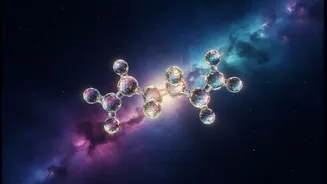
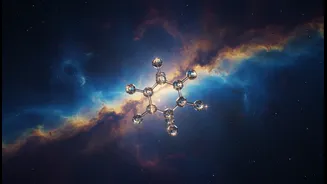
The molecule in question is erythrulose, a four-carbon sugar that, on Earth, is found naturally in things like red raspberries and is even used in some sunless tanning products. But its newest known location is far more exotic: a dense and chilly cloud
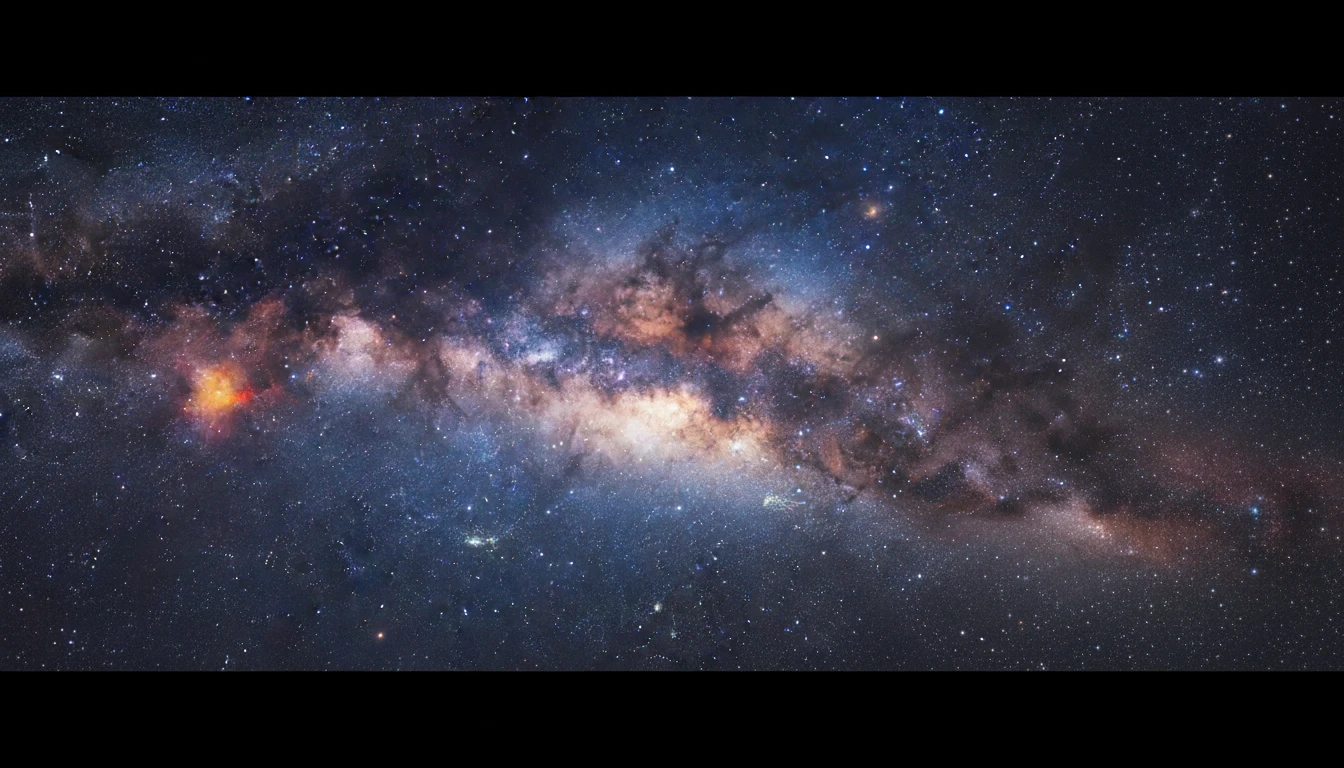
of gas and dust called G+0.693-0.027, located some 27,000 light-years away near the turbulent center of our Milky Way galaxy. An international team of scientists, led by researchers at Spain’s Center for Astrobiology, made the landmark discovery. These enormous molecular clouds are essentially stellar nurseries, the very places where new stars and planetary systems are born. Finding a complex organic molecule like a sugar here is like finding a key ingredient for a cake already sitting in the mixing bowl before the oven is even turned on.
Listening for Molecular Fingerprints
Detecting a specific molecule across thousands of light-years is a monumental task. It’s not a matter of looking through a telescope and seeing it. Instead, scientists use powerful radio telescopes to listen for the unique frequencies of energy that molecules emit as they rotate in the cold vacuum of space. Every molecule has a distinct spectral “fingerprint,” a set of signals on specific radio wavelengths. The team used the highly sensitive Yebes 40-meter and IRAM 30-meter radio telescopes in Spain to scan the target gas cloud. After painstaking analysis, they identified 12 distinct signals that perfectly matched the known laboratory fingerprint of erythrulose, providing undeniable evidence of its presence in the interstellar medium.
A Major Step Up in Complexity
While scientists have previously found sugar-adjacent molecules in space, this discovery is different. In 2000, astronomers detected glycolaldehyde, but with only two carbon atoms, it is not considered a “true” sugar by many chemists, who define the category as starting with three carbons. Erythrulose, with its four-carbon structure, is the first true sugar and one of the most complex non-cyclic molecules ever found between the stars. Furthermore, it is only the second “chiral” molecule found in the interstellar medium. Chirality, or “handedness,” is a crucial property of many molecules essential for life, including amino acids and sugars, which exist in left- or right-handed forms. Finding a chiral molecule of this complexity suggests that the chemical conditions in space are capable of producing the specific types of structures that life relies on.
Rewriting the Cosmic Recipe
The discovery of erythrulose also throws a fascinating wrench into existing theories of astrochemistry. The prevailing model suggested that complex molecules form incrementally, by adding one carbon atom at a time. If that were the case, astronomers would have expected to find simpler three-carbon sugars in much greater abundance than the more complex four-carbon erythrulose. Yet, their sensitive search of the same cloud revealed no trace of these simpler sugars, while erythrulose was comparatively plentiful. This surprising result suggests a different chemical pathway might be at play, perhaps one where two-carbon molecules combine on the icy surfaces of cosmic dust grains to form larger structures more directly. This opens up new possibilities for how the universe builds its chemical inventory.
Delivering Life's Ingredients From Space
For decades, one of the biggest questions in abiogenesis—the study of how life arises from non-living matter—has been the “sugar problem.” While sugars are vital for forming the backbone of RNA and DNA, lab experiments that simulate the conditions of early Earth struggle to produce them in sufficient quantities. This discovery provides a powerful alternative. If sugars can form efficiently in interstellar clouds, they could be incorporated into the asteroids and comets that form from that same material. Researchers estimate that during the “Late Heavy Bombardment” period around four billion years ago, millions of tonnes of erythrulose could have been delivered to Earth. This cosmic delivery service could have seeded the young planet with the prebiotic molecules needed to kickstart biology, suggesting the origin of life on Earth may have had a very extraterrestrial beginning.