





An Ambitious Leap to Orbit
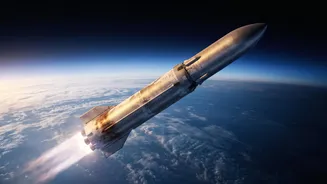
The mission on Monday, September 28, was a significant jump in ambition for SpaceX. After 13 suborbital test flights, Flight 14 was the first designed to actually enter and sustain a low-Earth orbit. The plan was audacious: launch from Starbase, Texas,
achieve orbit, deploy 26 next-generation Starlink V3 satellites, circle the Earth about six times, and then perform a controlled splashdown in the Pacific Ocean nearly 10 hours later. This wasn't just another test; it was Starship's debut as an operational payload delivery system, a crucial step toward its future of carrying massive cargo loads, and eventually, people to the Moon and Mars.
Drama in the Ascent
The ascent of the world's most powerful rocket was not without incident. Shortly after liftoff, one of the 33 Raptor engines on the Super Heavy booster shut down. The rocket, however, is designed with redundancy and continued its climb. After the stages separated, the Starship upper stage ignited its six engines to continue toward space, but then one of its powerful Raptor Vacuum engines also shut down prematurely. For several tense minutes, mission control deliberated. Initially, commentators on the live broadcast suggested the push for a full orbit would be abandoned. But after a rapid assessment of the vehicle's health, the call came through: "We are go for orbit." Starship used its remaining engines to compensate and successfully pushed itself into a stable orbit for the very first time, a moment met with cheers at SpaceX headquarters.
A Shortened but Successful Mission
Despite reaching orbit, the mission plan was about to change. With one engine down, SpaceX made the call to shorten the flight. The company stated that "out of an abundance of caution," they decided to end the mission after just a couple of orbits instead of the planned six. The original 10-hour flight was cut to just over three hours. Before its early return, however, Starship achieved its primary operational goal: deploying its payload. The vehicle successfully released 26 functional Starlink V3 satellites, which will join the company's global internet constellation. This marked the first time Starship had delivered an operational payload to orbit, proving its capability as a heavy-lift launch vehicle. The ship then performed a deorbit burn and executed its signature "belly-flop" reentry manoeuvre before splashing down in the Pacific Ocean north of Hawaii.
What This 'Successful Failure' Means
The headline-making events—an engine failure and a shortened flight—might sound like a significant setback. But within SpaceX's iterative development philosophy, Flight 14 is widely seen as a major success. The primary goals of reaching orbit and deploying a payload were both met. Each flight test, even with anomalies, provides invaluable data for improving the next vehicle. This "fail fast, test, and iterate" approach is what has allowed SpaceX to rapidly develop its rockets. The premature engine shutdown will be investigated, and any design or software fixes will be implemented on future flights. Experts note that understanding the cause of the failure is crucial for the program's timeline, especially with NASA depending on Starship for its future Artemis moon missions. For now, the mission demonstrated that the vehicle could suffer an engine failure during ascent and still complete its core tasks, a testament to its robust design.