






Who is Astrobotic?
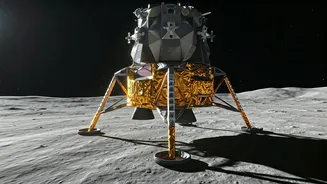
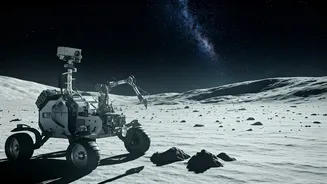
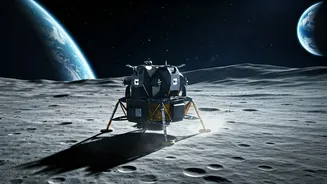
Founded in 2007 out of Carnegie Mellon University, Astrobotic is a robotics and aerospace company focused on making space more accessible. It specializes in developing lunar landers and rovers designed to carry payloads for governments, companies, and academic
institutions. The company has been a key partner in NASA’s Commercial Lunar Payload Services (CLPS) program, which aims to use private companies for lunar deliveries. However, its path has had challenges. Astrobotic's first lander, Peregrine, launched in January 2024 but suffered a critical fuel leak that prevented it from reaching the Moon. Despite this setback, NASA is demonstrating renewed confidence in the company, highlighting the agency's strategy of embracing both successes and failures as learning opportunities in this new commercial space race.
The $297.9M Mission
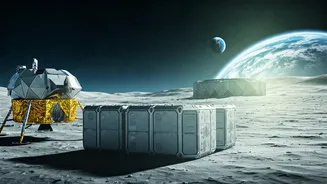
This latest contract tasks Astrobotic with delivering two separate Peregrine-class landers to a region near the Gruithuisen Domes by the end of 2028. This geologically fascinating area is a volcanic formation that scientists are keen to study. Each lander will transport a suite of NASA-sponsored instruments designed to gather crucial data for future human missions under the Artemis program. Key payloads include a spectrometer to monitor the lunar radiation environment, which is vital for understanding astronaut safety. Another instrument, a set of stereo cameras, will study how the lander's engine exhaust interacts with the lunar surface during descent—data that will make future landings safer. A laser retroreflector will also be deployed to serve as a permanent location marker for precise navigation in future missions.
NASA's New Strategy: The CLPS Program
This deal is a cornerstone of NASA's CLPS initiative, a program that fundamentally changes how the agency operates. Instead of building and operating its own spacecraft for every mission, NASA is now acting as a customer, buying payload space on privately-owned and operated landers. The total value of the recent awards to Astrobotic, Firefly Aerospace, and Intuitive Machines amounts to nearly $600 million for four missions. This approach is designed to foster a competitive commercial space economy, drive down costs, and increase the frequency of missions to the Moon. By partnering with multiple companies, NASA can accelerate its goal of building a sustainable human presence on the lunar surface as part of its overarching Artemis campaign.
A Global and Commercial Lunar Rush
Astrobotic's contract is part of a much larger story: a global rush back to the Moon, but this time with a strong commercial flavour. While nations like the US and China are in a strategic race, private companies are emerging as critical players. This new model opens up lunar access to more than just superpowers. Astrobotic's landers, for instance, will have additional capacity for commercial and international customers, carrying everything from university experiments to cultural artifacts. This creates a new lunar economy where sending something to the Moon is a service you can purchase. For India, a nation with its own highly successful and cost-effective lunar program in ISRO's Chandrayaan missions, this global shift presents both competition and opportunity. The commercialization of lunar logistics could open new avenues for collaboration and participation for Indian science and industry on the global stage.