

The Deception of Colour
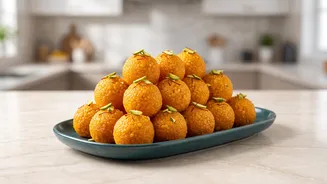
The first thing we notice about a motichoor laddu is its cheerful, inviting orange hue. This colour has become synonymous with festive joy. However, an unnaturally bright, fluorescent, or deep red-orange shade is often a red flag. Many sweet makers use
synthetic food colours like Sunset Yellow FCF (INS 110) or Tartrazine (INS 102) to achieve this look consistently and cheaply. While these are permitted by the Food Safety and Standards Authority of India (FSSAI) up to a certain limit (generally 100-200 parts per million), their overuse is a concern. Some studies have linked excessive intake of certain synthetic dyes to health issues, which is why relying on colour as a sign of quality is misleading. A naturally prepared laddu, coloured with a hint of saffron (kesar) or a minimal amount of permitted colour, will have a more subdued golden-orange or yellowish tone. This softer colour is often an indicator that the maker is focusing on ingredients rather than just appearance.
The Secret Is in the Texture
The real magic of a motichoor laddu is revealed in its texture. The name itself, ‘motichoor’, translates to “crushed pearls,” which perfectly describes how it should feel. Authentic motichoor laddus are made from minuscule droplets of gram flour (besan) batter, fried into tiny, soft pearls called boondi. This is what distinguishes it from the regular boondi laddu, which uses larger, more defined boondi. A high-quality motichoor laddu should be incredibly soft and delicate, holding its shape but breaking apart easily. The fine boondi should feel like it melts in your mouth, creating a smooth, luxurious experience rather than a coarse or grainy one. If the laddu feels hard, crumbly, or the boondi inside looks large and uneven, it’s likely not a true motichoor laddu. The art lies in frying the tiny boondi just enough to cook them without making them crisp, so they can properly absorb the sugar syrup and bind together perfectly.
Follow the Aroma of Purity
Your nose is one of the best tools for judging a laddu’s quality. A freshly made, high-quality motichoor laddu will carry the rich, nutty, and unmistakable aroma of pure ghee. This is because traditional recipes call for frying the boondi in ghee and often adding a bit more during the binding process. Besides ghee, you should be able to detect the subtle, fragrant notes of cardamom and perhaps saffron if it was used. Be wary of sweets that have an overpowering, perfume-like, or chemical smell, as this can indicate the use of artificial essences to mask low-quality ingredients. Another warning sign is the smell of vegetable oil or vanaspati (hydrogenated vegetable fat), which are cheaper alternatives to ghee and do not provide the same rich flavour or aroma. An authentic laddu smells natural and appetising, not artificial.
A Balance of Flavour and Freshness
Ultimately, the proof is in the tasting. A good motichoor laddu should be perfectly moist and sweet, but not cloyingly so. The flavour of the gram flour, enriched by the ghee, should come through, balanced by the sugar syrup and spices. It shouldn't just taste of sugar. The texture should not be greasy, which can happen if old oil is used or if the boondi absorbed too much fat. Nor should it be overly dry and crumbly, which suggests it is stale or the sugar syrup was not prepared correctly. A simple test for the quality of the fat used is to rub a small piece of the laddu on your palm. If it's made with pure ghee, it should start melting from your body heat, leaving a pleasant fragrance. If it leaves a greasy, waxy film, it likely contains vanaspati. Freshness is paramount, as a motichoor laddu is at its best when soft and moist.