




An Unsolved Solar Puzzle
For decades, astronomers have been puzzled by a few strange things about our solar system. When they look at other star systems, they frequently find “super-Earths”—rocky planets several times more massive than our own, orbiting close to their stars.
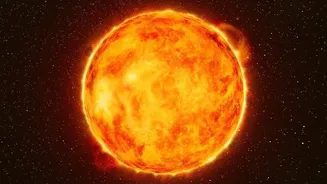
Yet, our system has none. Another mystery lies within the sun itself. Models of how stars like ours should evolve don't quite match what we observe, especially when it comes to the sun's internal structure and its surprisingly low amount of the element lithium. A recent study proposes a dramatic solution to these puzzles: what if our sun swallowed a planet in its youth?
The Case of the Missing Super-Earth
A team of researchers, led by Professor Mutlu Yildiz of Ege University in Turkey, published a study suggesting that a super-Earth may have formed in our early solar system. Using sophisticated computer simulations, they modelled the sun's evolution. They found that if a planet between five and ten times the mass of Earth spiralled inwards and was consumed by the sun billions of years ago, it would neatly explain the discrepancies we see today. This cataclysmic event would not only solve the mystery of why we lack a super-Earth but also account for the sun's unusual chemical composition and internal structure. The addition of a planet's heavier elements could have altered the sun in just the right way to match our current observations.
How to Swallow a Planet
The idea of a planet falling into the sun might sound like science fiction, but the early solar system was an unstable place. Protoplanetary disks, the swirling clouds of gas and dust from which planets are born, were thick with material. A newly formed planet could have its orbit decay by interacting with this dense gas, causing it to migrate slowly inward. Over millions of years, this inward spiral could bring it so close to the young sun that gravitational forces would pull it apart and consume it entirely. The researchers' models indicate that a rocky planet of sufficient size could penetrate deep into the sun before being completely vaporised, leaving a lasting chemical signature in its interior. The planet’s heavier elements, like iron and silicon, would have sunk into the sun's plasma, mixing with its core material.
Fingerprints Hidden in Starlight
This theory, while compelling, is based on computer modelling, not direct observation. However, it makes specific predictions that could one day be tested. Scientists study the sun's interior using a technique called helioseismology, which analyzes waves that travel through it, similar to how seismologists study earthquakes. Future, more precise observations might be able to detect the subtle structural and chemical fingerprints left behind by a consumed planet. The theory points to the sun's low lithium levels as a key piece of evidence. Lithium is easily destroyed at the high temperatures inside a star, and the engulfment of a massive planet could have stirred the sun's interior in a way that accelerated this process, explaining the deficiency we see today.
A More Complete Picture of Home
If this hypothesis proves correct, it would fundamentally change our understanding of how our solar system came to be. It would suggest that planetary systems are not just born but are actively sculpted by violent events and collisions long after their initial formation. The absence of a super-Earth in our system might not be because one never formed, but because it was sacrificed, its destruction possibly clearing the way for the smaller, stable rocky planets like Mercury, Venus, Earth, and Mars to thrive in their current orbits. This idea reminds us that the calm, predictable solar system we know today is the result of a turbulent and destructive past.