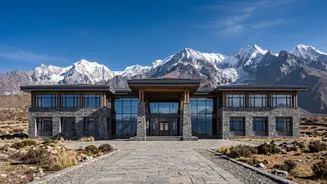









New Horizons in Higher Education
For decades, students from Ladakh seeking higher professional education often had to travel to distant cities, facing significant financial and personal challenges. That reality is set to change with the establishment of several new higher education institutions.
The administration has fast-tracked the creation of Ladakh's first Government Medical College in Leh, which is expected to admit its first batch of MBBS students for the 2027-28 academic year. The Union Ministry of Health and Family Welfare has approved the operationalisation and sanctioned 103 posts to allow for faculty recruitment even as the permanent campus at Spituk Pharka is under construction. In parallel, Ladakh is expanding into technical and management fields. MoUs have been signed to set up satellite campuses for both IIT Jammu and IIM Jammu in the region. The IIM Jammu campus in Leh is launching a BBA (Honours) programme, which has already seen significant interest from local students. Meanwhile, the IIT Jammu satellite campus will initially offer courses in Civil Engineering and Artificial Intelligence & Data Science, with a focus on skills relevant to Ladakh's unique environment, such as climate-resilient construction. These institutions represent a long-awaited opportunity for Ladakh's youth to pursue world-class education within their home region, a move described by Lieutenant Governor Vinai Kumar Saxena as a 'historic and transformational moment'.
Delivering Justice at the Doorstep
The other pillar of Ladakh's infrastructure push is the strengthening of its judicial system. In a landmark event, the first permanent bench of the High Court of Jammu and Kashmir and Ladakh was inaugurated in Leh in October 2026 by the Chief Justice of India. This development addresses a long-standing grievance of the local population. Previously, litigants had to undertake arduous and expensive journeys to Srinagar or Jammu for High Court matters, a trip that could take days by road and was often impossible during winter when mountain passes are closed. The new High Court bench, located at Melongthang, Leh, is designed to be a permanent sitting, not a temporary circuit. This means writ petitions and other high-level judicial matters can now be heard within the Union Territory itself. The facility is fully equipped with modern digital infrastructure, including video conferencing and paperless court capabilities, aiming to make the justice system more efficient and accessible. The establishment of the bench was enabled by a regulation promulgated by the President of India in August 2026, fulfilling a critical need for accessible legal recourse in the remote region.
A Foundation for Future Growth
These twin developments in education and justice are more than just new buildings; they are foundational investments in human capital and the rule of law. Since becoming a Union Territory in 2019, Ladakh has seen a concerted push in infrastructure development, from all-weather roads like the Zojila Tunnel to new airport terminals and hydropower projects. However, the focus on 'soft' infrastructure like universities and courts holds a different kind of significance. It signals a strategy aimed at fostering self-reliance, creating local opportunities, and integrating the region more deeply into India's national fabric. By providing local access to medical, technical, and management education, the administration aims to build a skilled workforce capable of driving Ladakh's future economy. This reduces the brain drain of talented youth who leave for education and may not return. Similarly, a functioning and accessible High Court bench strengthens governance, builds public trust, and ensures that the rights of citizens in one of India's most remote regions are protected. It ensures that geographical distance is no longer a barrier to justice.
The Broader Vision for Ladakh
The establishment of these institutions is part of a broader 'Vision 2047' for Ladakh, a long-term roadmap for sustainable development. The government has stated that the development of Ladakh is a top priority, with a focus on creating modern infrastructure while preserving the region's fragile environment and unique cultural heritage. The new judicial complex, for instance, includes a 'Green Wall' initiative and the installation of solar power systems, reflecting a commitment to sustainability. While the new projects are being celebrated as milestones, the path ahead involves ensuring these institutions are properly staffed and maintained in a challenging high-altitude environment. The long-term success of the medical college, IIT, IIM, and the High Court bench will depend on attracting and retaining high-quality faculty and staff. Nevertheless, these developments represent a clear and decisive step towards empowering the people of Ladakh, providing them with the tools of knowledge and the protection of law as they navigate the 21st century.