








The Architect of the AI Revolution
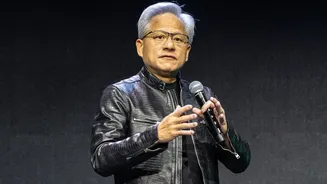
To understand the weight of Jensen Huang’s hypothetical departure, one must appreciate his role in building the modern AI landscape. Co-founding Nvidia in 1993 at a Denny's, Huang led the company from a niche graphics card maker for gamers into a global
titan. His defining strategic insight was recognizing that the parallel processing power of Graphics Processing Units (GPUs) could be used for more than just video games. This led to the 2006 launch of CUDA, a software platform that allowed developers to harness GPU power for general-purpose computing. This move, years ahead of the market, laid the essential groundwork for the deep learning explosion that would follow. Huang’s long-term vision and willingness to invest in technologies with uncertain immediate returns are legendary in Silicon Valley. He didn't just build a company; he created the very engine of the current AI boom.
Nvidia's Unbreachable AI Moat
Nvidia's dominance isn't just about having the fastest chips. The company's true competitive advantage, its 'moat', is the CUDA ecosystem. This collection of software libraries, tools, and developer support has been built over nearly two decades, creating a powerful lock-in effect. Over 4.5 million developers use the platform, and the world's most popular AI frameworks, like PyTorch and TensorFlow, are built on top of it. For a competitor, creating a rival chip is one thing; replicating this vast, mature, and deeply integrated software ecosystem is another challenge entirely. This strategy has given Nvidia a staggering market share in data centre GPUs, the core of AI infrastructure. The company doesn't just sell components; it now sells entire 'AI factories', integrated systems of hardware and software designed to produce AI. Any new leadership would inherit this formidable position, but also the pressure to defend it.
The Succession Question and Key Person Risk
A leader as dominant as Huang creates immense 'key person risk'. Reports have noted that Huang historically did not believe in formal succession planning, making his potential exit a particularly jarring event. While the company's board is filled with experienced directors, some of whom have been with Nvidia since its founding in 1993, no heir is apparent. In the event of a sudden change, the board appointed CFO Colette Kress as interim CEO. Kress is a highly respected finance chief who has been with Nvidia since 2013 and is a familiar voice to investors, but her background is primarily financial, not technical. Other potential internal candidates might include Ian Buck, a key figure in the development of CUDA, or Michael Kagan, the company's CTO. However, Huang's unique blend of technical vision, strategic conviction, and market-moving charisma is seen by many as irreplaceable.
Growth Strategy Under the Microscope
A post-Huang Nvidia would face immediate and intense scrutiny of its growth strategy. Would a new leader maintain the aggressive, long-term R&D bets that defined Huang's tenure? Or would they pivot to a more conservative, margin-focused approach to satisfy shareholder demands for short-term returns? Competitors like AMD and Intel, as well as major tech companies developing their own AI chips, would undoubtedly seek to exploit any uncertainty during a leadership transition. The new leadership would need to navigate complex challenges, from managing supply chains for next-generation chips like 'Blackwell Ultra' to navigating geopolitical trade restrictions. Furthermore, they would need to manage the evolving relationships with former key customers like OpenAI, which are now building their own AI infrastructure and becoming competitors in their own right.
The View from Wall Street
The market's reaction to a founder-CEO's departure can be dramatic. Studies show that when a highly successful founder leaves, the company's stock can take a significant hit. Analysts have predicted that Nvidia's value could decline substantially without Huang at the helm, as his vision is inextricably linked to the company's premium valuation. In the first earnings report following a hypothetical transition, investors would be watching interim CEO Colette Kress's every word for signs of continuity or change. While strong results might initially calm nerves, the long-term question would remain: can anyone else steer the ship with the same prescient vision that turned a graphics chip company into the world's AI powerhouse? The departure would force investors to re-evaluate whether Nvidia is a uniquely led organization or a durable institution that can outlast its architect.