




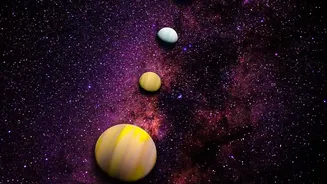

A Cosmic Crime Scene
Imagine trying to solve a crime with no witnesses, only a few strange clues left at the scene. This is the challenge astronomers face when they suspect a star has devoured one of its planets. For decades, the idea of planetary engulfment was a prediction.
In the chaotic dance of a young solar system, planets can be pushed into unstable orbits. Older stars, like our own Sun, will eventually swell into red giants, consuming their inner worlds. But spotting this in action is incredibly difficult. Instead, scientists often work like forensic detectives, looking for the chemical fingerprints a doomed planet might leave behind in its parent star's atmosphere. This field of 'necro-planetology' relies on finding elements that shouldn't be there.
The Chemical Evidence
Stars are mostly hydrogen and helium. Heavier elements, especially those common in rocky planets like Earth, are found in much smaller quantities. Certain elements, like lithium and beryllium, are particularly telling. These elements are typically destroyed inside a star's hot, turbulent interior early in its life. So when astronomers find a star that has an unusually high amount of lithium or other planet-forming elements like iron and magnesium, it raises a red flag. Recent studies have highlighted several such stars. One analysis of twin stars, which should be chemically identical, found one was significantly richer in lithium, beryllium, and other rocky materials, suggesting it had swallowed planetary matter equivalent to more than 10 Earth masses. This evidence forms the basis of a powerful scientific case.
Building a Believable Model
Finding a chemical anomaly is just the first step. To test their hypothesis, scientists turn to sophisticated computer models. They create simulations to see if adding a planet to the star's 'diet' could replicate the observed chemical signatures. These models factor in the star's mass, age, temperature, and the likely composition of the ingested planet. For example, researchers recently used a model to suggest our own Sun might have consumed a super-Earth early in its history, which could explain some of its unique chemical properties. When the output of the model closely matches the real-world observation, it provides strong support for the planet-swallowing theory. It’s a way of showing that the explanation is not just possible, but plausible.
Direct Detection: Catching It in the Act
A model, no matter how good, is an interpretation of evidence after the fact. A direct detection, on the other hand, is like having a video of the event as it happens. While rare, astronomers have had this breakthrough. In 2020, an event named ZTF SLRN-2020 provided the first real-time observation of a star engulfing a planet. Astronomers saw the star suddenly brighten by over 100 times, not because it got hotter, but because of a massive outburst of energy and material. This was followed by a glow in infrared light, indicating a cloud of dust was ejected as the Jupiter-sized planet was torn apart and consumed. This was not an interpretation based on leftover chemicals; it was observing the direct consequences of the engulfment as it unfolded.
Why the Distinction Matters
Differentiating between a model and a direct detection is fundamental to how science works. Both are valid and crucial tools. Models built on chemical evidence allow us to infer events that happened long ago, painting a picture of a solar system's violent history. They help us understand the frequency of these events and their impact on how planetary systems evolve. Direct detections, like ZTF SLRN-2020, provide the 'smoking gun' proof. They confirm that the events predicted by models do, in fact, occur and allow scientists to refine those models with real-world data. Overstating a model as a direct observation can be misleading. Science progresses by building theories, testing them with models, and seeking observational proof. Each step is vital, and being precise about the nature of the evidence ensures that our understanding of the universe is built on a solid foundation of rigour and honesty.