


A Vista of Galactic Pairs
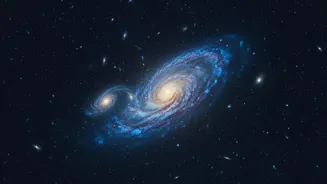
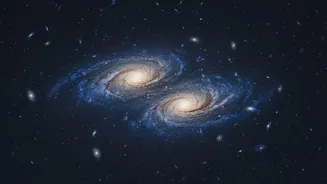
Recent images from space telescopes like Hubble and the James Webb Space Telescope have captivated the public with their stunning depth and clarity. One such type of image presents a seemingly crowded field of galaxies, with several appearing to be paired
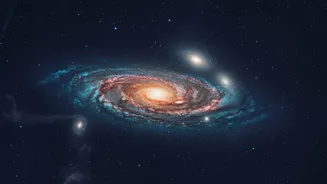
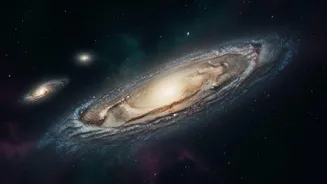
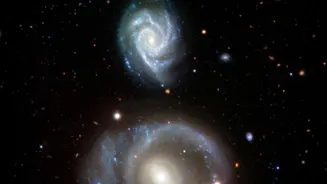
up. A notable example is the region around a formation known as Wild's Triplet. At first glance, the image seems to show three sets of interacting galaxies. This visual alignment sparks an immediate question: are these galaxies truly neighbours, locked in a gravitational dance, or are they ships passing in the cosmic night?
Cosmic Illusion vs. Interaction
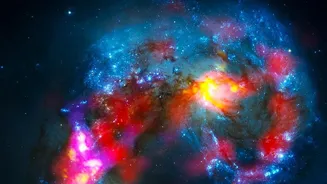
The truth is a mix of both. In the case of Wild's Triplet (also cataloged as Arp 248), two of the three main spiral galaxies are indeed interacting. They are approximately 200 million light-years from Earth and are connected by a massive bridge of stars, gas, and dust spanning 200,000 light-years. This 'tidal tail' was formed as their mutual gravity pulled material from each other during a close encounter. However, the third galaxy of the triplet, and another smaller spiral that appears right between the interacting pair, are optical illusions. They are actually background objects that are much, much farther away, merely aligned with the foreground pair from our viewpoint on Earth.
The Universe's Measuring Tape
So, how do astronomers tell the difference? They can't just lay out a tape measure. The key is determining each galaxy's distance. One of the most fundamental methods is measuring a galaxy's redshift. As the universe expands, distant galaxies are moving away from us. This movement stretches the light waves coming from the galaxy, shifting them toward the red end of the spectrum. The greater the redshift, the faster the galaxy is receding, and therefore, the farther away it is. By analyzing the light from each galaxy in the image, scientists can calculate their individual redshifts and discover that while two have similar values, indicating they are at a similar distance, the others are vastly different.
Standard Candles and Cosmic Lenses
Another crucial tool is the use of 'standard candles'—celestial objects with a known intrinsic brightness, like Type Ia supernovae. If astronomers see a supernova in a distant galaxy, they can measure its apparent brightness from Earth. By comparing this to its known real brightness, they can calculate the distance to its host galaxy with incredible precision. In some cases, gravity itself can help. Massive galaxy clusters can bend and magnify the light from galaxies behind them, a phenomenon called gravitational lensing. This can create multiple images of the same background galaxy, and by studying the distorted paths of light, scientists can deduce the distances involved.
Why These Cosmic Deceptions Matter
Distinguishing between true interactions and chance alignments is vital for understanding how galaxies evolve. Studying genuinely interacting systems like the main pair in Arp 248 reveals how gravitational tugs-of-war can trigger bursts of new star formation and eventually lead to galaxies merging into a single, larger one. These mergers are a fundamental process in the universe, believed to be how large galaxies like our own Milky Way grew to their current size. Meanwhile, the illusion of proximity is also useful, offering a clear view of background objects and sometimes allowing for the study of phenomena like gravitational lensing. Each cosmic snapshot, whether of a true partnership or a mere alignment, provides a valuable piece of the puzzle in our quest to understand the universe.