




A Glimpse into the Universe's Infancy
The discovery was made in a galaxy so distant that its light has traveled for 12.5 billion years to reach us. This means we are seeing it as it was just 1.2 billion years after the Big Bang, a period known as the 'Cosmic Dawn'. During this era, the very first
stars and galaxies were igniting, ending the cosmic dark ages and filling the universe with light. Observing this period is like finding a fossil from the universe's infancy. It is notoriously difficult to study, but crucial for understanding how the grand structures we see today, like our own Milky Way, came to be. This discovery provides an unprecedented snapshot of the violent and dynamic processes that shaped the early cosmos, suggesting it was even more chaotic than previously imagined.
An Unprecedented Cosmic Trio
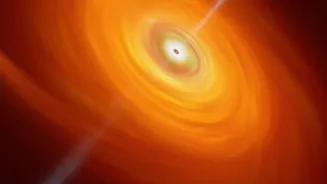
While most large galaxies host a single supermassive black hole at their center, the galaxy J0148-4214 is hoarding three. This is the first time such a system has been found in the distant, early universe. An international team led by researchers from the Max Planck Institute for Extraterrestrial Physics used the James Webb Space Telescope (JWST) to make the find. The three black holes are all actively 'feeding,' meaning they are furiously pulling in surrounding gas and dust, which makes them glow brightly enough to be detected across billions of light-years. Their masses are wildly different, estimated at around 80 million, 2 million, and 600,000 times the mass of our Sun. Finding three active black holes together suggests that the processes bringing them together were remarkably efficient in the universe's youth.
An Impossibly Close Encounter
What makes this discovery even more startling is the proximity of two of the black holes. The headline's "190 parsecs" refers to the distance between the two central black holes, which translates to roughly 620 light-years. While that sounds vast, in cosmic terms it is incredibly close—a tight embrace that challenges existing theories. This proximity suggests they are on a collision course that could see them merge in the future. The third black hole is a more distant companion, orbiting about 5,500 light-years from the central pair. This unique configuration—a tight central pair and a third, wider companion—provides a living laboratory for studying how black holes and galaxies grow through mergers.
Rewriting the History of Cosmic Growth
For years, a major puzzle in astronomy has been how supermassive black holes grew so enormous so quickly after the Big Bang. Standard models suggested a slower, more gradual growth. This discovery of a crowded, actively feeding black hole system provides a powerful answer: frequent and chaotic mergers. The finding implies that early galaxies may have frequently collided, bringing their central black holes together in these frantic dances. This rapid-fire merging process would have provided an accelerated growth path, helping to explain the existence of cosmic behemoths so early in the universe's history. According to the research team, this discovery sets the stage for the kind of massive black hole mergers that future gravitational wave observatories hope to detect.