




A Planet in Pieces
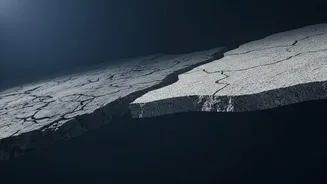
To understand Japan's situation, we first need to zoom out and look at the entire planet. The Earth's surface isn't one solid piece; it's a jigsaw puzzle of about 15 major slabs of rock called tectonic plates. These plates, which form the planet's crust
and upper mantle, are constantly moving, typically just a few centimetres per year—about the same speed your fingernails grow. They float on the hotter, more fluid mantle beneath them. Where these plates meet, interact, collide, or pull apart, we see the planet's most dramatic geologic activity, including the formation of mountains, volcanoes, and the violent shaking of earthquakes.
The Great Tectonic Collision
The process described in the headline—where one plate slides beneath another—is called subduction. This happens at what scientists call a convergent boundary, where two plates are moving toward each other. When an oceanic plate (which is denser) collides with a continental plate (which is lighter), the heavier oceanic plate is forced to dive down into the Earth's mantle. This isn't a smooth process. As the massive plates scrape against each other, their rough edges can get stuck, causing immense stress to build up over decades or even centuries. When the stress becomes too great, the rocks suddenly break or slip, releasing a phenomenal amount of stored energy in the form of seismic waves. That sudden release is what we experience on the surface as an earthquake.
Japan's Unlucky Geography
Japan's location is exceptionally complex, as it sits at the junction of four major tectonic plates: the huge Pacific Plate, the Philippine Sea Plate, the Eurasian Plate, and the North American Plate. Off the country's eastern coast lies the Japan Trench, a deep scar in the ocean floor where the massive Pacific Plate is being forced down, or subducted, beneath the continental plate that holds up the Japanese islands. This subduction is happening at a relatively fast pace of about 8 to 9 centimetres per year. This constant, powerful collision makes the region incredibly active, responsible for about 10% of all the world's earthquakes.
The Ring of Fire
Japan's tectonic position places it squarely within the 'Pacific Ring of Fire'. This is not a literal ring of fire but a nearly 40,000-kilometre, horseshoe-shaped belt that encircles the Pacific Ocean. This zone is defined by the boundaries of several tectonic plates and is home to the vast majority of the world's volcanoes and earthquakes. About 90% of all earthquakes, including most of the largest and most destructive, occur along the Ring of Fire. This is because it is lined with subduction zones, just like the one off the coast of Japan. The immense friction and heat generated as one plate grinds beneath another not only causes earthquakes but also melts rock, which can then rise to the surface to form the volcanoes that dot the region.
From Friction to Fury
The earthquakes generated in subduction zones are known as megathrust earthquakes and are the most powerful type on the planet. As the Pacific Plate dives beneath Japan, the immense pressure can cause the overriding continental plate to deform and eventually snap back into place, creating a massive earthquake. When this happens under the ocean, it can violently displace a huge volume of water, generating a devastating tsunami. While this constant geological threat is a fact of life, Japan has also become a world leader in earthquake preparedness, with advanced building codes, early warning systems, and extensive public education designed to mitigate the impact of its unique and turbulent position on Earth.