




Meet Asteroid Donaldjohanson
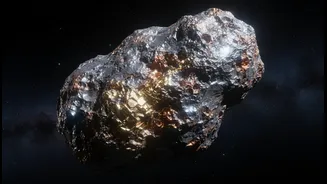
Located in the inner main asteroid belt between Mars and Jupiter, (52246) Donaldjohanson is not your average space rock. Named for the paleoanthropologist who discovered the famous 'Lucy' fossil, this asteroid was a key target for NASA's Lucy spacecraft,
which flew past it on April 20, 2025. The close-up images revealed a bizarre, peanut-shaped object, known as a contact binary. This means it's likely formed from two separate lobes that gently collided and stuck together, joined by a narrow neck. Scientists believe it was created from the debris of a larger asteroid collision around 155 million years ago, making it a relatively young object in cosmic terms.
A Surprising Wobble
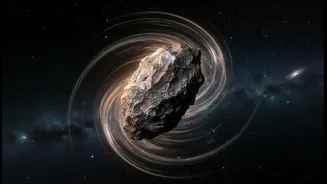
Before the Lucy flyby, scientists expected Donaldjohanson to have a fairly standard rotation. What they found was far more complex. Instead of spinning neatly on one axis, the asteroid has a chaotic, tumbling motion. It rotates end-over-end once every 10.5 days while also wobbling around its long axis every 26.5 days. This complex, two-axis spin is like a poorly thrown football tumbling through the air. This discovery was a surprise, challenging models of how such objects should behave. This wobbling spin is believed to be the result of a subtle but persistent force from sunlight, known as the YORP effect, which has altered its rotation over millions of years.
The 'Rubble Pile' Factor
Understanding Donaldjohanson's spin is especially important because it's considered a 'rubble pile' asteroid. This term doesn't mean it's space junk; rather, it’s a loose collection of rocks, boulders, and dust held together by its own weak gravity. Many, if not most, smaller asteroids are thought to be rubble piles. You might think this fragile structure would be easy to destroy, but the opposite is true. The empty spaces between the boulders act like a giant cushion, absorbing the shock from impacts that would shatter a solid, monolithic rock. This makes them incredibly resilient, with some rubble piles believed to be nearly as old as the solar system itself.
Spin, Not Just Stuff
This is where spin becomes a critical piece of the puzzle. Knowing an asteroid is a carbon-rich rubble pile tells you its composition, but its spin tells you about its structural integrity and behavior. A fast-spinning rubble pile would struggle to hold itself together, as centrifugal forces would threaten to fling its pieces apart. Donaldjohanson's slow, tumbling rotation helps explain how its two lobes can remain connected. The composition tells us about the solar system's history—in this case, evidence of iron-rich clays suggests the presence of liquid water on its parent body long ago. But the spin provides crucial insights into its current physical state and how it will react to outside forces.
Why This Matters for Planetary Defense
The findings have major implications for planetary defense. If a hazardous asteroid were ever on a collision course with Earth, we would need to know how to deflect it. Missions like NASA's DART, which successfully altered an asteroid's orbit by crashing a spacecraft into it, are our first steps in this direction. However, the success of such a mission depends heavily on the asteroid's properties. Hitting a solid rock is one thing; hitting a loose, spinning rubble pile is another. The impactor's energy might be absorbed by the porous structure, or a fast, wobbly spin could cause it to react in an unpredictable way. Understanding both the composition and the spin of an object like Donaldjohanson allows scientists to build more accurate models for how to safely nudge a dangerous asteroid out of our path without accidentally making the problem worse.