

From Icy Relic to Dynamic World
Before NASA's New Horizons spacecraft flew past Pluto in 2015, our best images showed little more than a blurry pixelated ball. Scientists widely assumed it was a geologically dead world, frozen solid for billions of years, pockmarked by craters and unchanged.
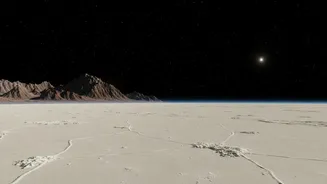
It was thought to be too small, too cold, and too far from the Sun to have the internal energy needed for any real activity. The flyby revealed a reality that was stunningly different. Instead of a static museum piece, New Horizons showed a world with vast plains, towering mountains made of water ice, and a hazy atmosphere. Most surprisingly, it revealed a massive, heart-shaped feature, the western lobe of which is a vast glacier of frozen nitrogen called Sputnik Planitia. This feature alone proved Pluto was far from dead.
A Heart of Flowing Nitrogen
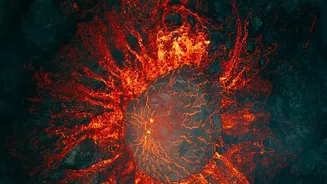
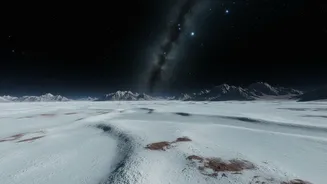
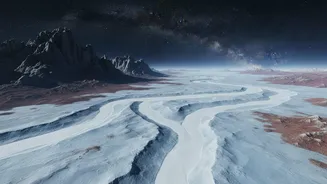
Sputnik Planitia, larger than Texas and Oklahoma combined, isn't a static sheet of ice. The surface is covered in city-sized polygonal cells, evidence that the solid nitrogen is churning in a process of slow convection, like a cosmic lava lamp. Fresher material from below constantly replaces the older surface ice. This process is possible because, at Pluto's frigid temperatures of around minus 230 degrees Celsius, nitrogen ice is relatively soft and pliable. It behaves like rock glaciers on Earth, slowly flowing and reshaping the landscape over time. This solid-state flow was a monumental discovery, showing that even in the solar system's deep freeze, there is enough energy for vigorous geological activity. The water ice on Pluto acts like bedrock, being too hard and brittle to flow, while the softer nitrogen glaciers move across it.
The Search for Liquid
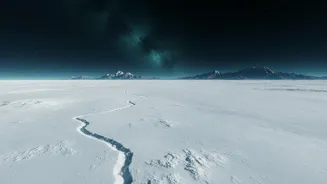
The discovery of flowing solid nitrogen was revolutionary, but the headline-making question has always been about liquid. For a long time, scientists speculated that in Pluto's past, when its orbit brought it closer to the Sun and its atmosphere was thicker, liquid nitrogen might have carved rivers and filled lakes. But the most recent evidence, based on a fresh analysis of the 2015 New Horizons data, suggests something even more profound: liquid nitrogen might have flowed on Pluto very recently. Published in August 2026, a new study highlights dark streaks and patches along the northern edge of Sputnik Planitia. These features look strikingly similar to patterns on Earth's glaciers that have been wetted by emerging subsurface water.
Flowing from Below
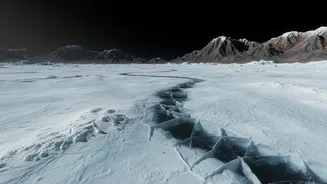
Since Pluto's thin atmosphere and extreme cold make nitrogen rain physically impossible, the liquid must be coming from somewhere else. Scientists now believe the most likely source is from beneath the glacier itself. Computer models show that at the base of the kilometers-deep Sputnik Planitia glacier, the immense pressure can melt the nitrogen ice, creating pockets of liquid. This liquid nitrogen could then be forced upward through cracks or conduits in the ice, briefly spilling out onto the surface before freezing again. This process, known as basal melting, would explain the dark, 'wetted' appearance of the features seen by New Horizons. This is the first direct evidence suggesting liquid has recently been expressed on Pluto's surface, completely changing our picture of it as a simple, frozen world.
Why It Matters for Icy Worlds
The evidence of both solid and potential liquid nitrogen flows on Pluto is significant because it provides a new blueprint for understanding geology in extreme cold. It proves that a world doesn't need the warmth of a nearby star to be geologically active. Pressure and composition are just as important. The processes happening on Pluto could offer insights into other mysterious bodies in the Kuiper Belt and even moons like Neptune's Triton, which also displays strange geyser-like activity. As Alan Stern, principal investigator of the New Horizons mission, stated, "Pluto never stops surprising us." Each discovery forces us to rethink the conditions required for dynamic planetary processes, suggesting the outer solar system may be filled with far more active and complex worlds than we ever imagined.