


A Tale of Two Planets
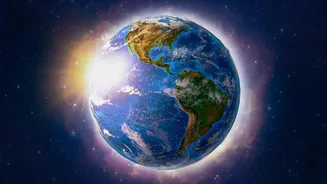
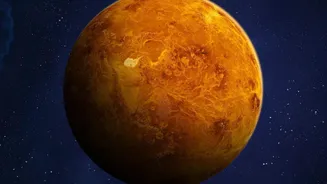
Earth and Venus are often called sister planets for good reason; they are remarkably similar in size, mass, and structure. Yet, they couldn't be more different. Earth is a vibrant world of oceans and life, while Venus is a scorching hothouse with surface
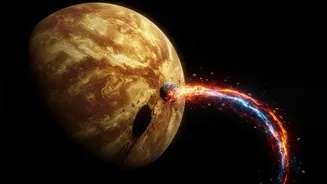
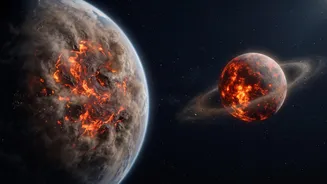
temperatures that can melt lead. One of the most glaring differences has always been the lack of a Venusian moon. Previous theories suggested that if Venus ever had a moon, it was likely destroyed by a massive impact, or perhaps the planet never had the right kind of collision to form one in the first place. But new research paints a far more intimate and dramatic picture: Venus may have been its own moon's undoing.
The Slow-Spinning Culprit
The key to this cosmic mystery, according to a recent study, is Venus's incredibly slow rotation. A single day on Venus lasts for 243 Earth days. This sluggish spin has a profound gravitational consequence. On Earth, our planet's relatively fast 24-hour rotation transfers energy to the Moon, causing it to slowly drift away from us at a rate of about four centimetres per year. However, simulations run by a team led by astrophysicist Stephen Kane at the University of California, Riverside, show the opposite would happen at Venus. The planet's slow spin and powerful gravity would create a tidal tug-of-war that it was destined to win, pulling any orbiting moon not outward, but inward toward its doom.
Simulating a Cosmic Crash
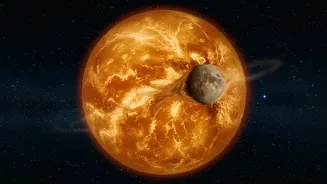
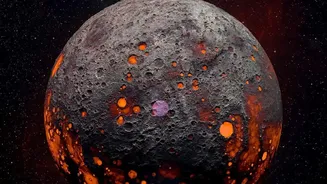
To test this hypothesis, researchers built computer models to simulate the gravitational dance between Venus and a hypothetical moon over billions of years. They tested a wide range of scenarios, varying the initial spin of Venus and the mass of its potential moons. The results were shockingly consistent. In most plausible scenarios, the moon would begin to spiral inward. Eventually, it would reach a point known as the Roche limit, where the planet's gravitational pull becomes so strong that it tears the moon apart, causing the debris to rain down and merge with the planet. Depending on the moon's initial mass and orbit, this catastrophic collapse could have happened in as little as 30 million years or taken as long as 1.7 billion years.
Searching for a Ghost Moon
While the study provides a compelling explanation, it is not definitive proof that Venus had a moon. Finding direct physical evidence is a monumental challenge. Venus underwent a massive volcanic resurfacing event roughly a billion years ago, which likely erased any craters or surface evidence of such a colossal impact. The clues, if they exist, may be hidden deep beneath the surface. Scientists believe Earth's own moon-forming impact left behind distinct structures in our planet's mantle, which can be detected with seismic studies. Future missions to Venus could perform similar measurements, potentially uncovering the geological ghost of a long-lost companion. The destruction of a moon could also have profoundly altered Venus's atmosphere and climate, possibly contributing to the runaway greenhouse effect that makes the planet so inhospitable today.