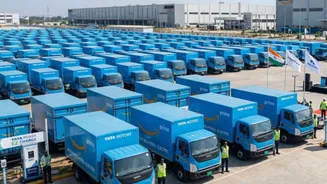









In a major boost for India's green logistics ambitions, Tata Motors and Amazon have joined forces to deploy 3,000 electric trucks across the e-commerce giant's nationwide transportation network. This is a landmark moment for India's EV ecosystem.
The Deal in Detail
The collaboration,
announced on October 27, 2026, will see Tata Motors supply 3,000 electric trucks, starting with the Tata Ultra E.7 model, to be integrated into Amazon's middle-mile and inter-city freight operations. Unlike last-mile delivery vans, these trucks will handle the heavy lifting of moving goods between Amazon's fulfillment centers, sortation hubs, and delivery stations. The deployment will be phased over three years, with the initial rollout beginning in Delhi to coincide with the busy festive season. The arrangement is structured so that Amazon's third-party carrier partners will own and operate the trucks, with Tata Motors providing the vehicles and operational support. This model ensures that the financial and operational aspects are viable for small and mid-sized transport operators.
A Strategic Win for Tata Motors
For Tata Motors, India's largest commercial vehicle manufacturer, this partnership is a massive vote of confidence in its electric vehicle technology. A confirmed order for 3,000 units from a single, high-volume client like Amazon provides the kind of stable, predictable demand that is crucial for scaling up manufacturing. It validates the commercial viability of electric trucks, moving them from pilot projects into large-scale, practical application. Rajesh Kaul, Vice President of Trucks at Tata Motors, highlighted that the collaboration goes beyond just supplying vehicles; it includes providing essential support for charging infrastructure and servicing. This end-to-end approach helps address key barriers to EV adoption and demonstrates that zero-emission trucks are a practical business proposition for fleet operators.
Amazon's Green Mile Gets Longer
This deal marks Amazon's most significant step yet to electrify its fleet beyond the last mile. The company has already deployed over 15,000 electric vehicles for last-mile delivery in more than 500 Indian cities. By targeting the middle mile, Amazon is addressing one of the tougher challenges in decarbonizing logistics. This initiative is a core part of Amazon's global commitment to The Climate Pledge, which aims for the company to achieve net-zero carbon emissions by 2040. Abhinav Singh, an Amazon Vice President, stated that the company is setting a 'bold vision to scale electric trucking' and that this collaboration is an important move toward that goal. The partnership also includes working on vehicle configurations specifically suited for e-commerce, focusing on maximizing space for cargo that is often voluminous but lightweight.
The Ripple Effect on India's EV Ecosystem
A project of this scale has the potential to create a powerful ripple effect across India's entire EV ecosystem. The plan includes electrifying the 2,800nd kilometre Delhind Bengalurund Chennai corridor along NH48, one of India's most critical freight routes. To support this, dedicated charging infrastructure and hubs are being developed in partnership with providers like Yahhvi. This guaranteed demand for charging along a major highway can spur further investment in public charging infrastructure. The deal also aligns with government initiatives like PM Endrive and Delhind s 2026 EV Policy, which provides incentives for electric trucks. This synergy between corporate action and public policy is crucial for accelerating the transition to green logistics and realizing the vision of a 'Viksit Bharat 2047', as noted by Union Minister H.D. Kumaraswamy.