









The Ghostly Messenger
Neutrinos are strange, elusive subatomic particles. They are born from some of the most powerful events in the cosmos: exploding stars, gamma-ray bursts, and the swirling chaos around supermassive black holes. Unlike light or charged particles, which
get bent by magnetic fields or absorbed by dust, neutrinos travel in a straight line from their source, carrying a pure, uncorrupted message across billions of light-years. The catch? They are so non-interactive they are called 'ghost particles'. Trillions pass through your body every second without a trace. Catching even one is a monumental feat of science.
A Trap in the Antarctic Ice
This is where the IceCube Neutrino Observatory comes in. Located at the South Pole, it is the world's largest neutrino detector. It isn't a traditional telescope with a lens; instead, it uses a cubic kilometer of pristine, deep Antarctic ice. More than 5,000 sensors, called Digital Optical Modules, are suspended on 86 strings, buried up to 2.5 kilometers beneath the surface. They wait in the dark. When a rare neutrino happens to crash into an atom in the ice, it creates a shower of secondary particles that emit a faint blue flash of light, called Cherenkov radiation. By analyzing this flash, scientists can reconstruct the neutrino's energy and, crucially, the direction it came from.
A High-Energy Alert
On December 8, 2021, the IceCube alert system triggered. The detector had registered a 'track-like' event, the signature of a particularly high-energy neutrino with an estimated energy of 172 TeV. This was a big deal. The event, dubbed IceCube-211208A, sent an automatic alert to astronomers worldwide, telling them, in essence, 'look over here'. Just hours later, another neutrino telescope, the Baikal-GVD in Russia, detected a neutrino from the same patch of sky. The game was afoot.
The Prime Suspect: A Blazar
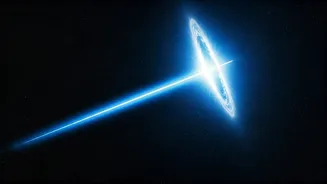
Following the neutrino's path back across the sky, astronomers quickly found a prime suspect: a blazar known as PKS 0735+178. A blazar is a type of active galactic nucleus, a galaxy with a supermassive black hole at its center that is actively feeding on surrounding gas and stars. This process unleashes unimaginable amounts of energy, shooting twin jets of ionized matter out from the black hole's poles at nearly the speed of light. A blazar is simply an active galaxy whose jet is pointed directly at Earth, making it appear exceptionally bright. When the neutrino alert went out, telescopes noticed PKS 0735+178 was in the middle of a major flare, erupting across the electromagnetic spectrum—from gamma rays to optical light.
Why 'Shadow Blaster'?
The nickname 'Shadow Blaster' comes from a complication in the story. Some reports on similar phenomena use this term when the source is obscured by dust, making it hard to see in visible light. In the case of PKS 0735+178, the association isn't straightforwardly one-to-one. The blazar is technically just outside the 90% probability region for the neutrino's origin. However, scientists note this isn't a dealbreaker. Small systematic errors in the detector or the simple fact that 10% of true sources will lie outside this region means the link is still very plausible. The simultaneous flare in the blazar provides strong circumstantial evidence, suggesting it's the cosmic particle accelerator responsible.
The Dawn of a New Astronomy
This event is a fantastic example of multi-messenger astronomy, a new era where scientists combine data from different 'messengers'—like light (photons), neutrinos, and gravitational waves—to get a complete picture of a cosmic event. While the connection between the 2021 neutrino and PKS 0735+178 isn't yet confirmed with absolute certainty, it represents another crucial step forward. It follows a similar breakthrough in 2017 that linked another IceCube neutrino to a different blazar, TXS 0506+056. Each new association helps scientists understand how nature builds these immense particle accelerators and unlocks the secrets of the most violent and energetic processes in our universe.