





Meet the Cosmic Detective
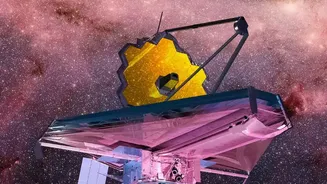
The instrument behind this discovery is NASA's SPHEREx, which stands for Spectro-Photometer for the History of the Universe, Epoch of Reionization, and Ices Explorer. Launched in 2025, this space telescope has a unique and powerful job: to scan the entire
sky in near-infrared light. While our eyes see a limited range of colours, SPHEREx sees 102 different 'colours' of infrared light. This technique, called spectroscopy, allows scientists to determine what cosmic objects are made of and how far away they are. Every six months, the observatory completes a full map of the cosmos, providing an unprecedented amount of data not just on distant galaxies, but also on the strange objects lurking in our own cosmic neighbourhood. And among its primary targets are some of the most mysterious objects in the galaxy: brown dwarfs.
Neither Star nor Planet
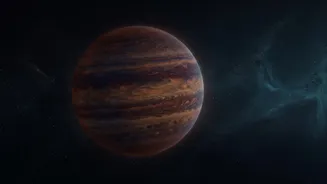
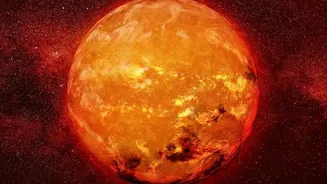
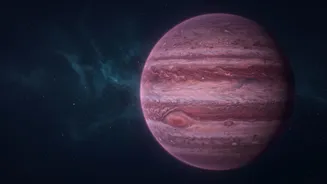
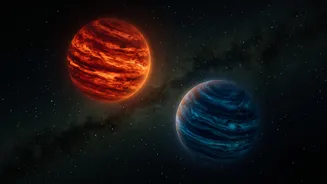
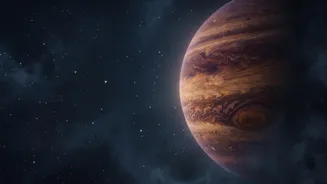
So, what exactly is a brown dwarf? Often called 'failed stars', these objects occupy a fascinating middle ground. They form from collapsing clouds of gas and dust, just like stars do. However, they never accumulate enough mass to ignite and sustain the nuclear fusion of hydrogen in their cores, the process that makes stars shine brightly. They are, in a sense, cosmic underachievers. Their mass falls in a specific range—generally between 13 and 80 times the mass of Jupiter. Below this range, you have a planet. Above it, you have a star. Because they don't burn hydrogen, brown dwarfs are dim, cool, and incredibly difficult to spot, mostly emitting a faint glow in the infrared spectrum. Despite their name, they would likely appear magenta or reddish to the human eye.
Blurring a Fundamental Line
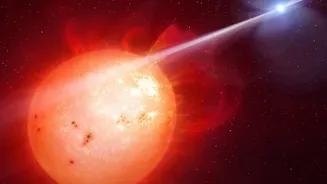
The discovery of thousands of these objects by SPHEREx is monumental because it directly challenges the neat dividing lines we draw between stars and planets. While some brown dwarfs form in isolation like stars, others might orbit stars like planets. The key difference often comes down to mass and the ability to fuse deuterium, a heavy form of hydrogen. Objects above about 13 Jupiter masses can briefly fuse deuterium, putting them in the brown dwarf category. But what about an object with 12 times Jupiter's mass? Is it a massive planet or a tiny brown dwarf? The answer is not always clear, and the formation process—whether it grew in a disk around a star or collapsed on its own—is another point of debate among astronomers. By providing a massive catalogue of these in-between objects, SPHEREx gives scientists a statistically powerful sample to study this ambiguous boundary like never before.
Why Thousands of Failed Stars Matter
Finding a few brown dwarfs is interesting, but finding thousands opens up a new frontier in astronomy. This vast new population allows scientists to move from studying individual curiosities to understanding the group's overall characteristics. According to recent findings from the mission, the atmospheres of these objects are chemically rich, containing water, methane, and carbon dioxide, much like the gas giants in our solar system. However, the models scientists use to predict their behaviour and weather are struggling to match the diverse data SPHEREx is sending back, showing that no two brown dwarfs are exactly alike. Studying this diverse menagerie helps us understand how common different types of objects are in the galaxy, refine our theories of star and planet formation, and even investigate the kinds of environments that might exist on worlds untethered from a host star.